




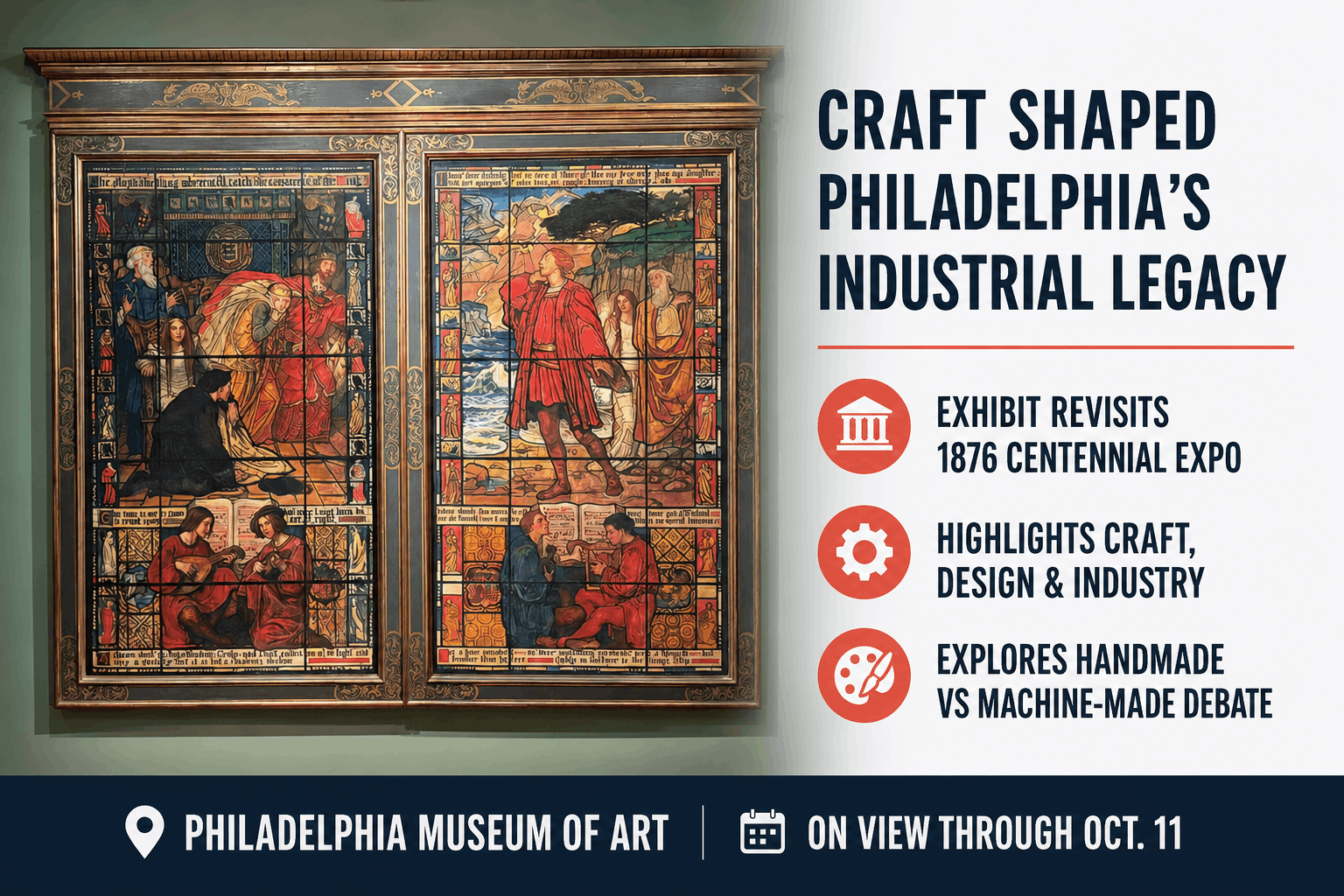
The Philadelphia Museum of Art’s “Workshop of the World” revisits the 1876 Centennial Expo and shows how craft, design and industry reshaped American making.
Craft, Industry and a City of Makers
The Philadelphia Museum of Art is using its new exhibition, “Workshop of the World: Arts & Crafts in Philadelphia,” to tell a story that began 150 years ago at the 1876 Centennial Exposition. The show looks at how the fair exposed both the strength and the weakness of American manufacturing, especially when international exhibitors brought work that outshone much of what the United States had to offer. That moment pushed Philadelphia’s designers, makers and institutions to rethink how art and industry could work together.
The exhibition also matters because the museum itself grew out of that same world’s fair. What began as the Pennsylvania Museum and School of Industrial Art later became the Philadelphia Museum of Art, and its roots in industrial education still shape the institution’s identity. The new exhibition uses that history to explore how craft became a serious cultural and economic force in the city.
Centennial Expo Sparked Change
Curators David Barquist, Elisabeth Argo and Colin Fanning frame the Centennial Exposition as the turning point that exposed the tension between American design and global standards. Visitors saw that many American goods lacked the refinement and visual appeal of products from Europe and Asia. That realization inspired reformers to improve both manufacturing and design so Philadelphia could remain a serious industrial center.
The exhibition shows how the Centennial became a catalyst for the American Arts and Crafts movement. It connects the world fair to a larger debate about what counts as art, what counts as craft and how commercial design fits into that equation. In Philadelphia, these questions were not theoretical; they shaped how the city made things, sold things and trained the next generation of makers.
Handmade vs Machine-Made
One of the exhibition’s central themes is the debate between handmade work and industrial production. The ideas of British designer William Morris spread widely at the time, and he argued for returning to individual craftsmanship instead of mass manufacturing. His influence reached Philadelphia, where many people began asking whether machine-made goods had stripped workers of autonomy and creativity.
The show does not present craft as a simple alternative to industry. Instead, it reveals a more complicated reality: some celebrated artisans also used industrial methods, even while promoting the handmade ideal. That tension gives the exhibition its intellectual energy and makes it relevant today, especially as people continue to question the role of automation and artificial intelligence in creative work.
Makers Who Bridged Both Worlds
The exhibition highlights several Philadelphia figures who lived between craft and industry. Henry Mercer, for example, built a successful tile business that still produces work today using original Arts and Crafts molds. His example shows that a craft-based brand could survive commercially, even if the production process itself relied on repetition and factory discipline.
Samuel Yellin presents a similar contradiction. He earned a reputation as a master metalworker and publicly emphasized his personal hand in every piece, yet he ran a workshop with as many as 250 employees. His story shows how artisans balanced artistic identity with business expansion in a city shaped by manufacturing. The exhibition uses these examples to show that craft and industry were never completely separate categories.
Communities Built Around Craft
The show also looks at the artisan communities that formed in the Philadelphia region, including Arden, Rose Valley and New Hope. These places attracted craftspeople who wanted to live and work in settings that celebrated handmade production and artistic independence. They became symbolic of the Arts and Crafts ideal, even if their economic models were not always sustainable over the long term.
By including these communities, the exhibition expands the story beyond objects and makers. It shows how craft shaped entire ways of life, influencing where people lived, how they worked and what kinds of communities they tried to build. That broader perspective helps visitors see craft as both an artistic practice and a social vision.
Why It Still Matters
“Workshop of the World” arrives at a time when many of the same questions feel newly urgent. Curator Elisabeth Argo draws a direct line from the Arts and Crafts movement to present-day concerns about AI, authenticity and the value of human labor. Her point is simple: people still want to know what is real, who made it and whether creative work reflects human judgment or machine output.
The exhibition suggests that craft remains meaningful because it carries both cultural and ethical weight. It reminds visitors that handmade objects are not just beautiful; they also represent labor, skill and intention. In that sense, the show uses Philadelphia’s past to ask timely questions about the future of making.
Visiting the Exhibition
“Workshop of the World” is on view at the Philadelphia Museum of Art through Oct. 11. The exhibition offers a rich look at how one city helped shape the American Arts and Crafts movement and how those debates continue to echo today. For visitors interested in design history, industrial heritage or the value of handmade work, it offers both context and relevance.
#PhiladelphiaMuseumOfArt #WorkshopOfTheWorld #ArtsAndCrafts #CentennialExpo #CraftHistory #DesignHistory #WilliamMorris #SamuelYellin #HenryMercer #HandmadeVsMachineMade
Disclaimer
The information in this article is based on available public sources and official statements as of the time of publication. While we aim for accuracy, we do not guarantee completeness or correctness. We advise readers to verify key details from official sources before making any decisions. The website (fashionsamvaad.com) is not liable for any loss or damage arising from the use of this content. The authors are also not responsible for any such loss or damage.