




In Panchgani, Devrai Art Village empowers tribal artisans to evolve Dhokra metalwork through shared authorship, innovation and sustainable contemporary design.
A Sanctuary for Craft
Amid the misty hills, red soil and dense greenery of Panchgani in Maharashtra, Devrai Art Village is creating a new future for India’s traditional metalwork. The collective brings tribal artisans and contemporary designers together, allowing an ancient craft to evolve without losing its cultural and technical roots.
The village takes its name from devrai, the sacred groves of Maharashtra that local communities have protected for generations out of respect for nature. This connection with the environment shapes both the philosophy and the work of the collective.
Devrai Art Village operates as a non-profit space that challenges the long-standing separation between urban artists and traditional artisans. Instead of treating craftspeople as producers of decorative objects, it recognises them as creative collaborators with valuable knowledge, experience and artistic authority.
Breaking the Artist-Artisan Divide
For decades, the global art market often placed contemporary artists above traditional craftspeople. Galleries promoted urban creators through individual names and premium prices, while artisans were frequently pushed into regional craft markets and expected to reproduce familiar tourist products.
Devrai Art Village follows a different model. Indigenous craftspeople, particularly members of Dhokra-making communities from Chhattisgarh and Gadchiroli, work alongside visiting designers and urban creatives. They share ideas, experiment with materials and develop new forms together.
Designers learn by working directly with master artisans. Rather than imposing external concepts on traditional techniques, they observe how artisans understand wax, clay, soil, heat and metal. This process creates genuine collaboration and allows the craft community to influence the final design.
The collective also gives artisans individual credit for their work. It treats them as equal partners instead of anonymous makers behind a designer’s name.
The Ancient Dhokra Technique
Dhokra is a lost-wax metal-casting technique with roots that extend back thousands of years, including the period of the Indus Valley Civilisation. Artisans first create a clay core and cover it with wax threads to form patterns and surface details.
They then encase the wax model in a layer of local soil and allow the mould to dry naturally. When artisans heat the mould, the wax melts and leaves a hollow space. They pour molten brass into this space, allowing the metal to take the shape of the original design. After the mould cools, they break it open and finish the brass object by hand.
The process leaves behind small variations, textures and marks that demonstrate the human character of the craft. Each piece carries evidence of the artisan’s decisions and the material’s response to heat.
Innovation Through Rock Dhokra
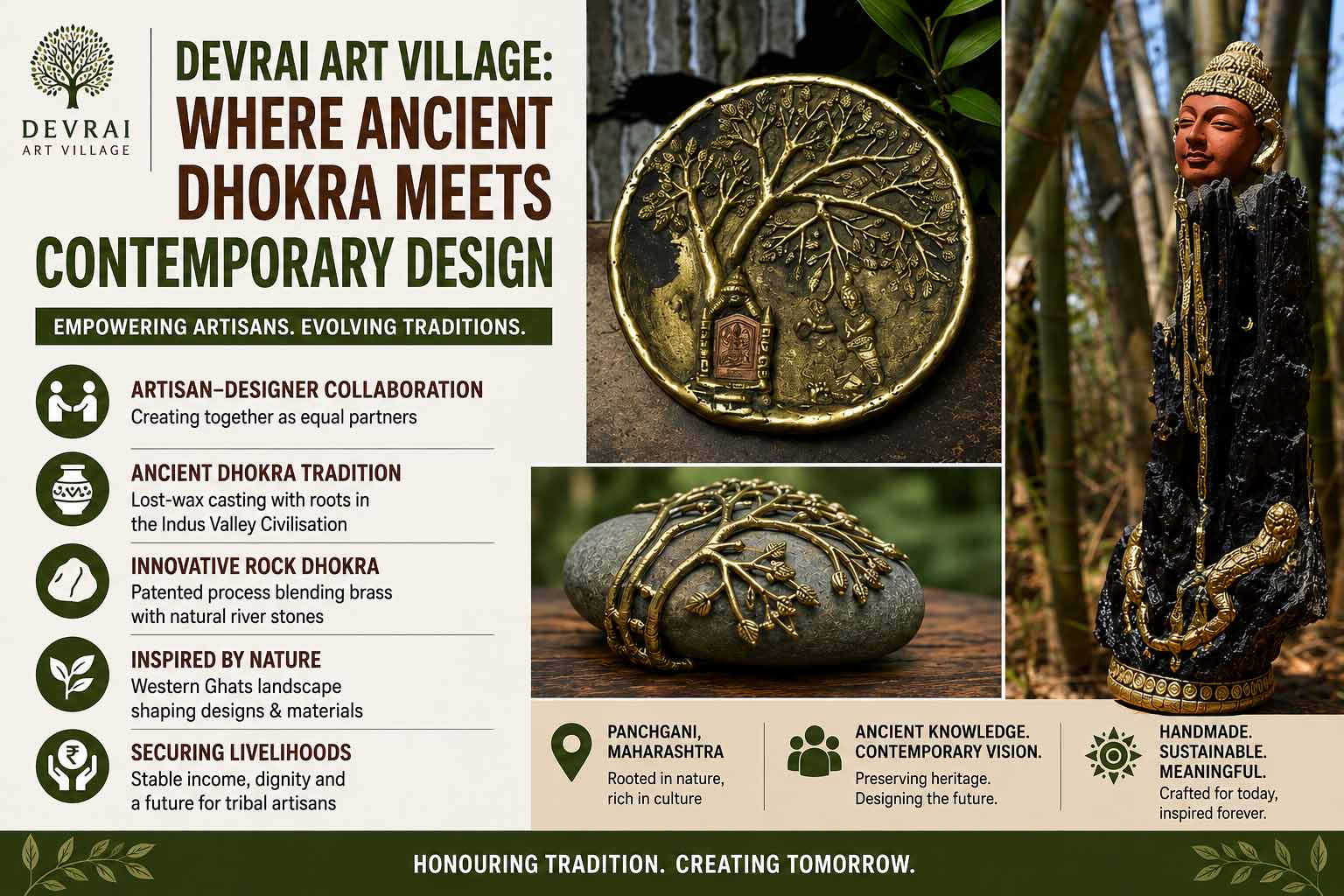
Devrai Art Village has expanded the possibilities of Dhokra through Devrai Rock Dhokra, a patented process developed at the workshop. In this method, artisans cast molten brass directly onto naturally shaped river rocks.
Combining brass and stone creates demanding technical conditions because the two materials respond differently to heat. Artisans must carefully control the temperature and timing of the pour. Their success depends not only on formal measurements but also on deep practical intuition developed through repeated experience.
The resulting pieces combine detailed brass tendrils and geometric patterns with the irregular surfaces of weathered stone. The collective uses this method to create both functional products, such as door handles, and sculptural works.
Rock Dhokra shows how traditional knowledge can generate new design possibilities. The innovation does not replace the original technique; instead, it extends its visual and practical language.
The Western Ghats as Inspiration
The landscape around Panchgani plays an active role in the collective’s creative process. Artisans often work outdoors beneath tree canopies and study natural forms directly. Dragonflies, fungi, seed pods and spiderwebs become references for patterns and structures.
Nature also supplies many of the materials used in the work. Artisans collect river rocks, fallen branches and local clay to develop moulds and forms. Soil beds, manual tools and charcoal furnaces keep the process connected to basic natural elements.
The open-air setting supports a slower rhythm of production. Lost-wax casting depends on conditions such as complete sun-drying, while larger brass-and-stone pieces may require several attempts. Individual projects can take several weeks to complete.
Economic Security and Creative Agency
Devrai Art Village offers more than a workspace. Many artisans who move there come from remote regions of Central India affected by economic and social instability. The village provides stable income, residential accommodation, shared meals and opportunities to participate in creative decision-making.
This support allows artisans to focus on their work while developing new designs. It also helps preserve traditional skills through active employment rather than static demonstrations or museum displays.
The collective’s approach links cultural preservation with economic dignity. When artisans receive recognition, fair compensation and creative ownership, traditional knowledge becomes more sustainable for future generations.
A Contemporary Design Future
Devrai Art Village presents a practical alternative to mass-produced home décor. Factory-made objects often depend on uniform plastic moulds and standardised finishes, while Dhokra retains the marks of handwork, material variation and individual judgement.
The collective demonstrates that indigenous crafts can respond to contemporary interiors and changing consumer preferences without abandoning their original technical identity. By combining tribal expertise with modern design thinking, Devrai creates objects that are both rooted and forward-looking.
In Panchgani, ancient metalwork continues to evolve-not through imitation, but through collaboration, experimentation and respect for the artisans who carry its knowledge.
#DevraiArtVillage #DhokraArt #RockDhokra #TribalMetalwork #LostWaxCasting #Panchgani #IndigenousCrafts #ContemporaryIndianDesign #ArtisanCollaboration #SustainableCraftsmanship
Disclaimer
The information in this article is based on available public sources and official statements as of the time of publication. While we aim for accuracy, we do not guarantee completeness or correctness. We advise readers to verify key details from official sources before making any decisions. The website (fashionsamvaad.com) is not liable for any loss or damage arising from the use of this content. The authors are also not responsible for any such loss or damage.