

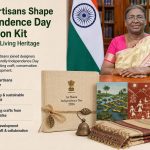


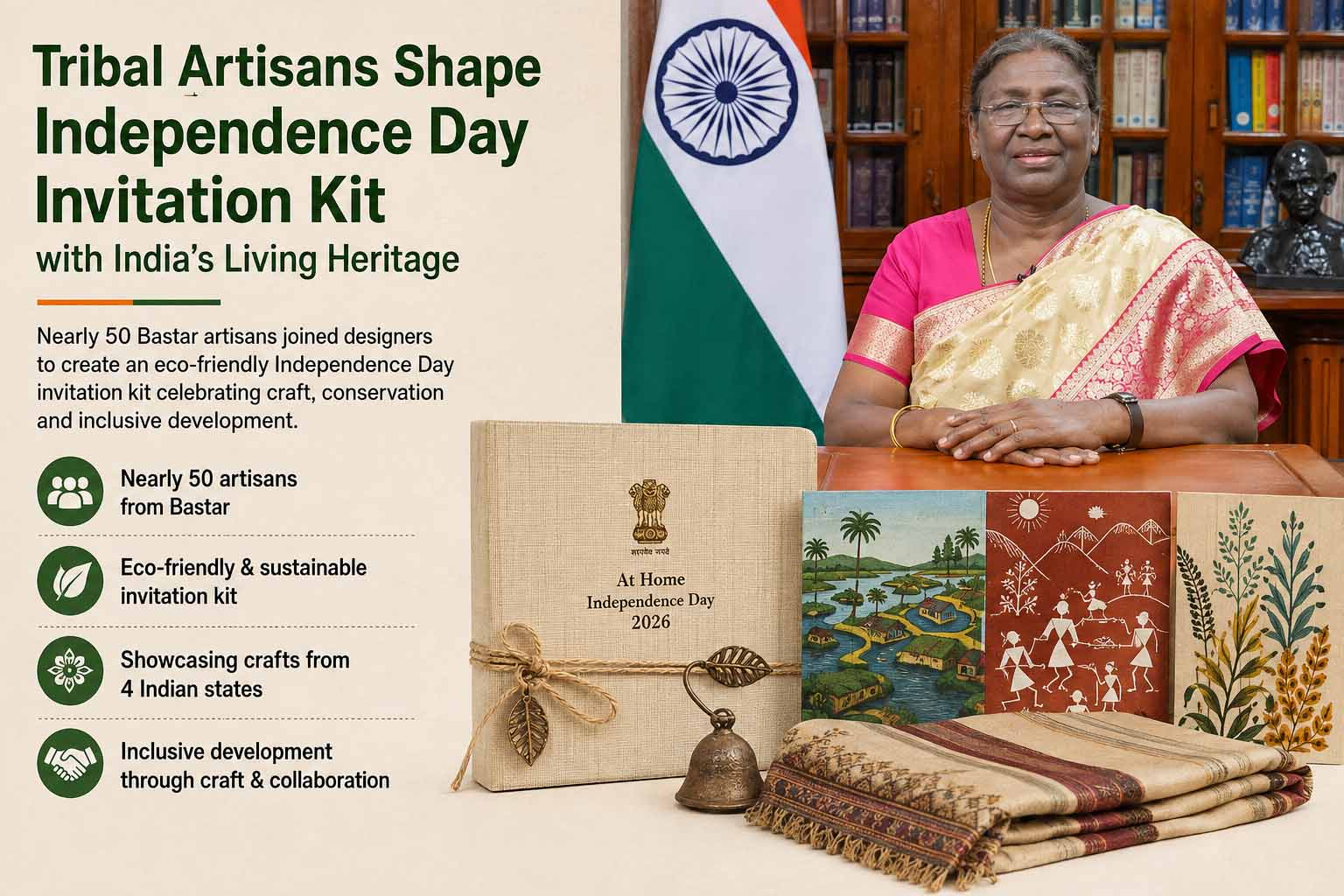
Nearly 50 Bastar artisans joined designers to create an eco-friendly Independence Day invitation kit celebrating craft, conservation and inclusive development.
A Handmade National Tribute
Nearly 50 artisans from Chhattisgarh’s Bastar region joined a team of about 130 craftspeople, designers, students and faculty members to create the 2026 Independence Day “At Home” invitation kit hosted by President Droupadi Murmu.
The handmade package brought together traditional crafts and environmental stories from Chhattisgarh, Goa, Maharashtra and Madhya Pradesh. Officials from Rashtrapati Bhavan and the National Institute of Design (NID), Ahmedabad, conceptualised the kit around the United Nations Sustainable Development Goals. The final design promoted sustainability, cultural preservation, inclusion and livelihood opportunities for artisan communities.
The project became particularly significant because nearly 50 participating artisans came from Bastar, a region once affected by Left-Wing Extremism. Their involvement reflected how inclusive development can create new economic opportunities while placing indigenous skills on a national platform.
Craft, Design and Collaboration
NID Director Ashok Mondal said artisans, designers, students and faculty members worked on the project for more than three months. They used traditional and eco-friendly techniques to create the invitation package on behalf of the President of India.
The collaboration moved beyond the conventional division between designer and craft worker. Instead of using artisans only to execute pre-decided ideas, the project incorporated their knowledge, techniques and cultural perspectives into the design process.
The kit connected everyday craft practices with larger national themes. It showed how communities, creativity and conservation depend on one another, particularly in regions shaped by forests, rivers, wetlands and traditional agricultural systems.
Bastar’s Dhokra and Pitwa Crafts
The invitation kit showcased Dhokra casting, one of India’s oldest metal-casting traditions. The craft represents the deep cultural heritage of Chhattisgarh and the relationship between tribal communities and nature.
It also featured Pitwa, a wrought-iron craft associated with Bastar. Artisans transformed recycled scrap iron into minimalist sculptures and useful objects. Unlike cast metalwork, Pitwa artisans hand-forge each piece from a single rod or sheet of metal.
A handcrafted wrought-iron bell accompanied the address slip. Skilled tribal ironsmiths in Bastar made the bell from recycled scrap iron, demonstrating how discarded material can become a functional and visually striking object.
The craft element also reflected the region’s tradition of protecting sacred groves. These community-preserved forest spaces express a longstanding understanding of conservation and the importance of maintaining a balance between people and the natural environment.
Goa’s Khazan Wetlands
The invitation used Azulejo tile painting to depict Goa’s Khazan lands, community-managed coastal wetlands reclaimed from mangrove forests and marshes.
For centuries, local communities have maintained this agro-aqua ecosystem through dykes, embankments and sluice gates. These structures regulate tidal water and prevent saltwater from damaging agricultural fields. At the same time, the system supports paddy cultivation, fishing and salt-panning.
The Khazan landscape represents a traditional nature-based defence system. Its inclusion in the invitation highlighted how local knowledge can protect communities from environmental pressures while supporting food production and livelihoods.
Maharashtra’s River Restoration
A Warli painting in the kit represented the restoration of the Kham River in Chhatrapati Sambhajinagar, Maharashtra. The project brought together local institutions, environmental groups and community members to rebuild the relationship between residents and the river.
The restoration work included waste management, water treatment, plantation of native species and the renewal of shared public spaces. These interventions gradually helped transform the river corridor into a more resilient ecological landscape.
The Warli artwork connected the environmental project with Maharashtra’s distinctive tribal visual tradition. Warli painting uses simple forms and rhythmic compositions to represent nature, community life and everyday experiences.
Madhya Pradesh’s Seed Heritage
The kit also featured Bhil artwork from Madhya Pradesh. The painting highlighted community-led seed preservation practices that protect indigenous varieties of grains, pulses and vegetables adapted to local climates and food systems.
Bhil painting is known for its vibrant colours and intricate patterns of dots. Artists commonly use neem twigs to create depictions of nature, mythology and daily life. Through the invitation, the art form also communicated the importance of biodiversity and community control over agricultural knowledge.
Seed preservation helps communities retain crop varieties suited to local environments. It also protects food traditions and strengthens resilience in the face of changing ecological conditions.
A Stole Bringing Regions Together
Guests attending the Independence Day reception were welcomed with a specially designed Maheshwari stole. Handwoven in Maheshwar, Madhya Pradesh, the stole used the traditional combination of silk and cotton associated with Maheshwari weaving.
Its design brought together motifs from four regional textile traditions. These included the Kinar border of Maharashtra’s Karwat Kathi saree, the Rudraksha border of Goa’s Kunbi saree, the Kangra motif of Maheshwari weaving and the Chinta Chowk motif from Chhattisgarh’s Panika tradition.
By combining these design vocabularies, the stole created a single textile expression of regional diversity. It also demonstrated how traditional weaving can communicate cultural connections across states.
Craft as Inclusive Development
The invitation kit turned a formal national ceremony into an opportunity to recognise artisans and their knowledge. It gave Bastar craftspeople visibility while presenting traditional practices as relevant to sustainability, design and public life.
The project showed that handmade objects can carry several messages at once. They can preserve cultural memory, create livelihoods, support environmental awareness and encourage innovation.
Through Dhokra, Pitwa, Warli, Bhil and Maheshwari traditions, the kit celebrated India’s artistic diversity. More importantly, it honoured the artisans who continue to keep these traditions alive and showed how inclusive collaboration can connect heritage with the country’s future.
#TribalArt #DhokraCraft #PitwaCraft #NIDAhmedabad #SustainableDesign #IndianHandicrafts #WarliArt #MaheshwariWeaving #BastarArtisans
Disclaimer
The information in this article is based on available public sources and official statements as of the time of publication. While we aim for accuracy, we do not guarantee completeness or correctness. We advise readers to verify key details from official sources before making any decisions. The website (fashionsamvaad.com) is not liable for any loss or damage arising from the use of this content. The authors are also not responsible for any such loss or damage.