







NABARD Rajasthan marked National Handloom Day by promoting technology, design, finance and market access to empower rural artisans and strengthen handloom livelihoods.
Celebrating India’s Handloom Heritage
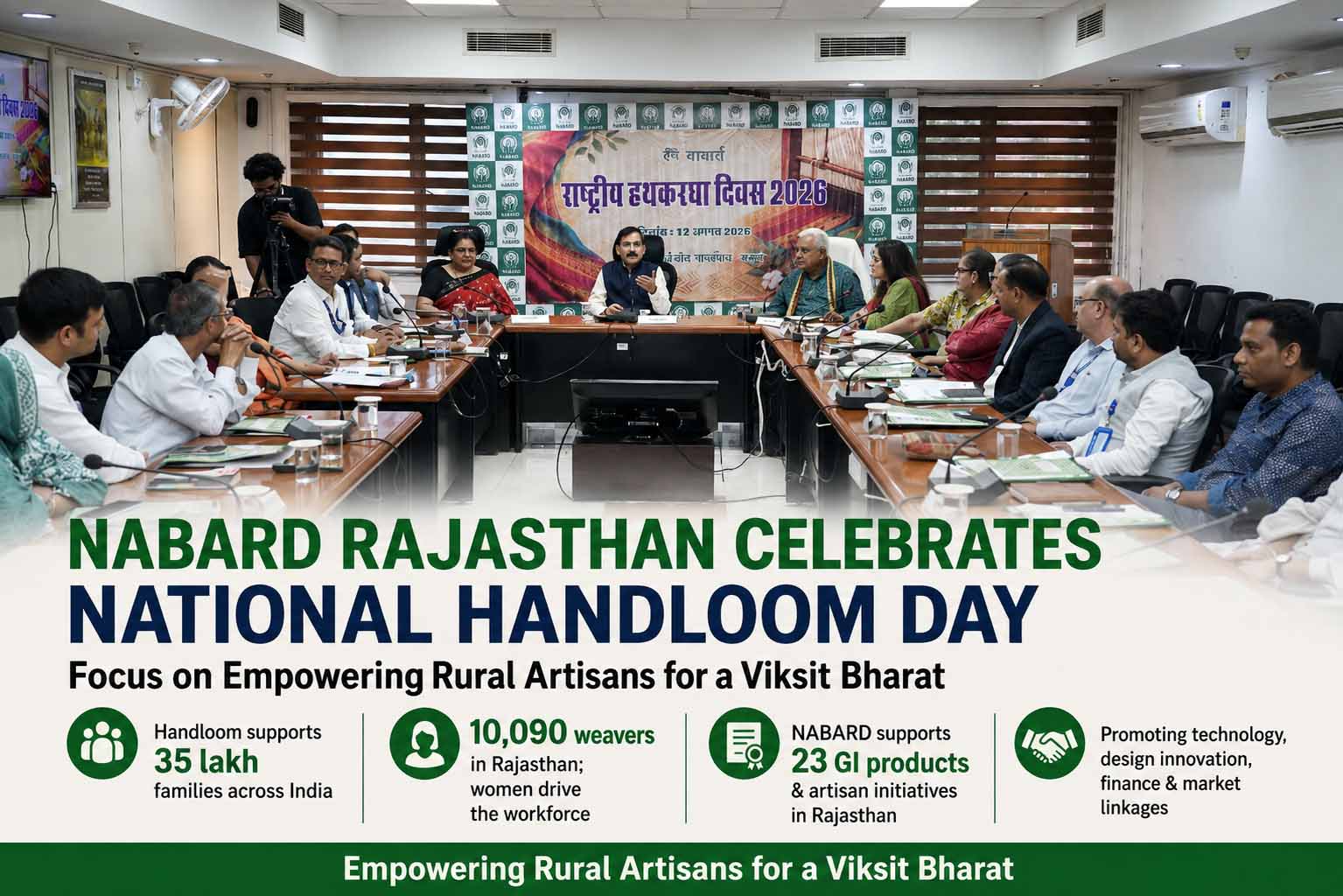
The NABARD Rajasthan Regional Office celebrated the 12th National Handloom Day under the theme “Empowering Rural Artisans for a Viksit Bharat.” The programme focused on strengthening the handloom and handicraft sector through technology, design innovation, credit access, market linkages and institutional cooperation.
The event was inaugurated by Dr. R. Ravi Babu, Chief General Manager, NABARD, Rajasthan, and Shri Ram Kishore Chhipa, Padma Shri awardee and renowned Bagru artisan. Artisans, designers, government officials, representatives of financial institutions, non-governmental organisations and producer collectives participated in the programme.
National Handloom Day, observed every year on 7 August, recognises India’s weaving heritage and the contribution of handloom communities to the country’s cultural and economic life. The day also recalls the Swadeshi Movement of 1905, which encouraged the use of indigenous products and promoted self-reliance.
Handloom as a Rural Livelihood
In his inaugural address, Dr. R. Ravi Babu highlighted the importance of handloom and handicrafts in supporting rural livelihoods. Referring to the Handloom Census 2019–20, he noted that the sector supports around 35 lakh families across India and provides livelihoods to 10,090 weavers in Rajasthan.
Women form a significant part of the handloom workforce, making the sector an important instrument for women’s economic empowerment. By generating employment within villages and small towns, handloom production can reduce migration and help families build more stable sources of income.
Dr. Ravi Babu explained that NABARD supports both farm and non-farm sectors as part of its approach to integrated rural development. He called for stronger coordination among government departments, financial institutions, designers, NGOs, market agencies and artisan organisations.
Technology and Design Innovation
The NABARD official stressed that artisans need access to appropriate technology and contemporary design inputs to remain competitive. Traditional skills provide the foundation of handloom production, but artisans must also respond to changing consumer preferences, new markets and evolving product requirements.
Participants discussed ways to improve design development, product diversification, packaging, branding and quality. These measures can help artisans move beyond conventional products and create items suited to modern homes, workplaces and lifestyle markets.
Design innovation can also preserve traditional techniques by adapting them to current demand. When artisans combine established weaving knowledge with new colours, formats and applications, they can attract younger consumers without losing the identity of their craft.
NABARD’s Support Initiatives
Dr. Ravi Babu outlined several initiatives through which NABARD has supported Rajasthan’s handloom and handicraft communities. The organisation has helped promote GI certification and Authorised User registration for 23 products in Rajasthan.
Geographical Indication recognition can protect the identity of region-specific products and help consumers distinguish authentic goods from imitations. However, artisans also require assistance with marketing and enterprise development to gain commercial value from such recognition.
NABARD has supported Rural Marts and Rural Haats, which give artisan groups physical spaces to display and sell their products. It has also promoted Producer Organisations, exhibitions, skill-development programmes and entrepreneurship-development initiatives.
These interventions aim to improve artisans’ market access, strengthen collective production and build business capabilities. They can help producers negotiate better, purchase raw materials collectively and approach larger buyers with greater confidence.
Learning from Bagru Craft
Shri Ram Kishore Chhipa encouraged artisans and designers to bring India’s diverse handloom traditions together. He cited the possibility of combining the visual language of Bagru printing with the textile traditions of Chanderi sarees to create innovative products with wider market appeal.
His suggestion underlined the value of collaboration across regions and craft forms. Such exchanges can generate fresh designs while allowing artisans to learn from one another.
Shri Chhipa also appealed to citizens to wear handloom at least once a week. Regular consumer support, he said, could help artisans earn a livelihood and preserve India’s textile heritage. Consumer choices play an important role in sustaining handmade production because every purchase can support a weaver, dyer, printer or artisan family.
Discussion on Sector Challenges
The programme included detailed discussions on technology adoption, design innovation, artisan collectives and stakeholder convergence. Participants examined government schemes, financing options, skill requirements and market opportunities in the handloom and handicraft sector.
They also discussed grassroots challenges, including limited access to affordable credit, inadequate infrastructure, insufficient exposure to contemporary designs and difficulties in reaching organised markets. Improved institutional support can help address these issues.
The event brought together Ms. Archana Surana, Founder and Director of ARCH College of Design & Business; National Awardee Shri Raj Kumar Pandey; Dr. Santosh Kumar Dhanopiya; and representatives of the State-Level Bankers’ Committee, the Development Commissioner (Handicrafts), District Industries Centre, KVIC, TRIFED and NGOs.
Interactive Exchange with Artisans
The programme concluded with an interactive session in which artisans and stakeholders shared their experiences. Artisans discussed production-related concerns, access to markets and the need for continuous skill and design support.
The exchange allowed officials and sector experts to understand challenges directly from the people involved in handloom and handicraft production. Participants also explored collaborative measures for the sustainable growth of Rajasthan’s artisan economy.
Building a Viksit Bharat
The National Handloom Day programme reinforced the idea that rural artisans form an important part of India’s development story. Stronger finance, technology, design, infrastructure and market networks can help traditional producers improve their incomes while preserving cultural knowledge.
By connecting artisan communities with institutions, designers and buyers, NABARD’s initiative created a platform for practical solutions. The programme demonstrated that empowering rural artisans requires more than appreciation of heritage-it requires sustained investment, fair market access and coordinated action.
#NationalHandloomDay #NABARDRajasthan #RuralArtisans #ViksitBharat #IndianHandloom #BagruCraft #ChanderiSaree #ArtisanEmpowerment #GIProducts #HandloomHeritage
Disclaimer
The information in this article is based on available public sources and official statements as of the time of publication. While we aim for accuracy, we do not guarantee completeness or correctness. We advise readers to verify key details from official sources before making any decisions. The website (fashionsamvaad.com) is not liable for any loss or damage arising from the use of this content. The authors are also not responsible for any such loss or damage.