






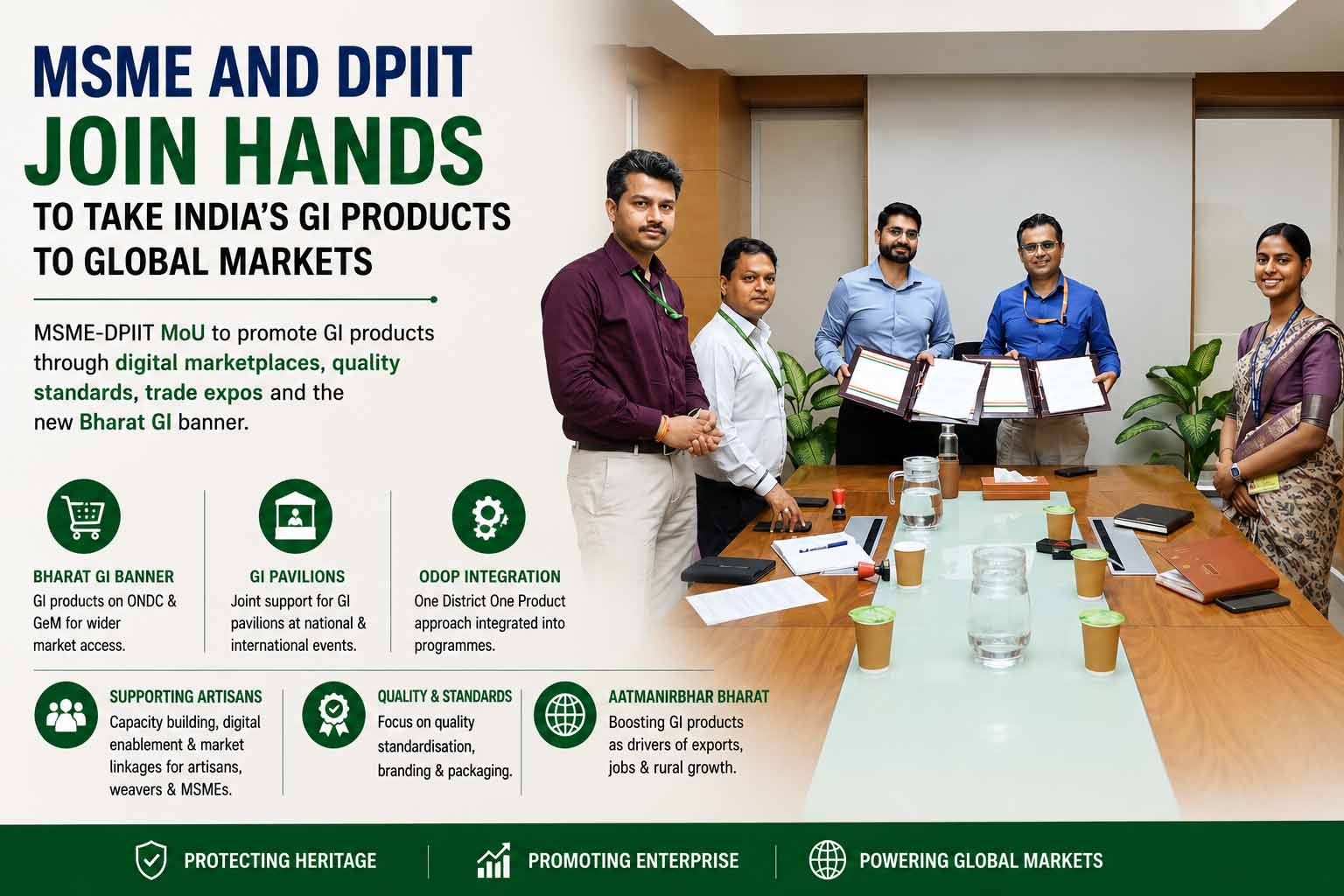
The MSME-DPIIT MoU will promote India’s GI products through digital marketplaces, quality standardisation, trade expos and the new Bharat GI banner.
A New Push for GI Products
The Ministry of Micro, Small and Medium Enterprises and the Department for Promotion of Industry and Internal Trade (DPIIT) have signed a Memorandum of Understanding to accelerate the commercialisation and global market access of India’s Geographical Indication (GI) products.
The two organisations signed the MoU on 5 August 2026 at Vanijya Bhawan in New Delhi. Md. Salik Parwaiz, Director in the Ministry of MSME, and Karan Thapar, Director of the Intellectual Property Rights Division at DPIIT, signed the agreement in the presence of senior officials from both institutions.
The partnership aims to move GI products beyond local and regional markets and help artisans, weavers, producers and small enterprises build commercially viable businesses. It combines DPIIT’s role in protecting intellectual property with the MSME Ministry’s responsibility for enterprise development, finance, capacity building and market support.
From Legal Protection to Enterprise Growth
A GI tag identifies a product with a particular geographical origin and recognises qualities, reputation or characteristics linked to that location. Registration protects the product’s regional identity and prevents unauthorised use of its name.
However, legal protection alone does not guarantee commercial success. Many GI products still face challenges such as limited branding, inconsistent quality, inadequate packaging, weak distribution networks and poor access to national and international buyers.
The new MoU addresses this gap. It creates a framework to help regional products become scalable, market-ready and export-oriented enterprises. The collaboration will support quality standardisation, capacity building, digital enablement and stronger market penetration.
The initiative also intends to improve livelihoods for indigenous artisans, weavers and producer collectives. By connecting traditional producers with organised markets, the government hopes to increase demand and create more sustainable income opportunities.
Bharat GI Banner Introduced
One of the most important features of the agreement is the launch of the “Bharat GI” banner. Under this initiative, GI collectives and authorised users will receive support to join the Open Network for Digital Commerce (ONDC) and the Government e-Marketplace (GeM).
ONDC can help producers reach consumers through a wider digital commerce network. It can also reduce dependence on a single platform and provide opportunities for small businesses to participate in online trade.
GeM, India’s public procurement platform, can connect eligible GI producers with government buyers. This access could create new demand for regional products and encourage producer groups to improve cataloguing, packaging, documentation and delivery systems.
The Bharat GI identity can also create a common platform for presenting India’s regional products. A recognisable banner may help buyers identify authentic GI goods and strengthen consumer confidence.
Integrating GI with ODOP
The Ministry of MSME and DPIIT will integrate the One District One Product (ODOP) approach into their programmes and interventions. ODOP focuses on promoting products associated with particular districts and supporting the local ecosystems behind them.
The integration can help align GI registration with district-level enterprise development. It may bring together artisans, producer companies, self-help groups, exporters, local administrations and support institutions.
This approach can also improve coordination. Instead of treating GI protection, product development, marketing and exports as separate activities, the new framework seeks to connect them through a unified support system.
For districts known for textiles, handicrafts, agricultural products or processed goods, the partnership could provide a structured path from production to branding and market access.
GI Pavilions at Trade Events
The two organisations will jointly support dedicated GI pavilions at national and international trade expos, buyer-seller meetings and exhibitions. These pavilions will give producers opportunities to display their products directly before retailers, importers, exporters, institutional buyers and consumers.
Physical exhibitions remain important for handmade and regional products because buyers often need to examine the material, finish, design and authenticity before placing orders. Direct interaction can also help producers understand changing market preferences.
International trade events can introduce Indian GI products to new markets and encourage partnerships with overseas distributors. Domestic exhibitions, meanwhile, can build awareness among Indian consumers and strengthen demand for authentic regional goods.
Supporting Artisans and MSMEs
The agreement places artisans, weavers and producer collectives at the centre of the GI ecosystem. Many small producers possess strong technical skills but lack access to finance, digital tools, branding specialists and professional market networks.
Capacity-building programmes can help them improve production planning, quality control, labelling, packaging, e-commerce operations and export documentation. Digital onboarding support may also make it easier for traditional producers to list products and manage online orders.
The partnership can benefit women-led enterprises, rural entrepreneurs, cooperatives, self-help groups and small manufacturing units associated with GI products. Greater market access can encourage younger members of artisan communities to continue traditional occupations while exploring new designs and business models.
Strengthening Aatmanirbhar Bharat
The MoU supports the government’s broader vision of Aatmanirbhar Bharat and Vocal for Local. It seeks to convert India’s cultural and regional diversity into sustainable economic opportunity.
The initiative does not treat GI products merely as symbols of heritage. It presents them as potential drivers of enterprise growth, exports, employment and rural development. To achieve that goal, however, implementation will remain crucial. Producers will need timely handholding, transparent quality standards, reliable logistics and fair returns.
The MSME-DPIIT partnership marks an important step towards building a more connected GI ecosystem. Through the Bharat GI banner, digital marketplaces, ODOP integration and dedicated trade platforms, India’s regional products may gain stronger visibility at home and abroad.
#BharatGI #GeographicalIndication #MSME #DPIIT #GIProducts #ONDC #GeM #OneDistrictOneProduct #IndianHandicrafts
#VocalForLocal
Disclaimer
The information in this article is based on available public sources and official statements as of the time of publication. While we aim for accuracy, we do not guarantee completeness or correctness. We advise readers to verify key details from official sources before making any decisions. The website (fashionsamvaad.com) is not liable for any loss or damage arising from the use of this content. The authors are also not responsible for any such loss or damage.