



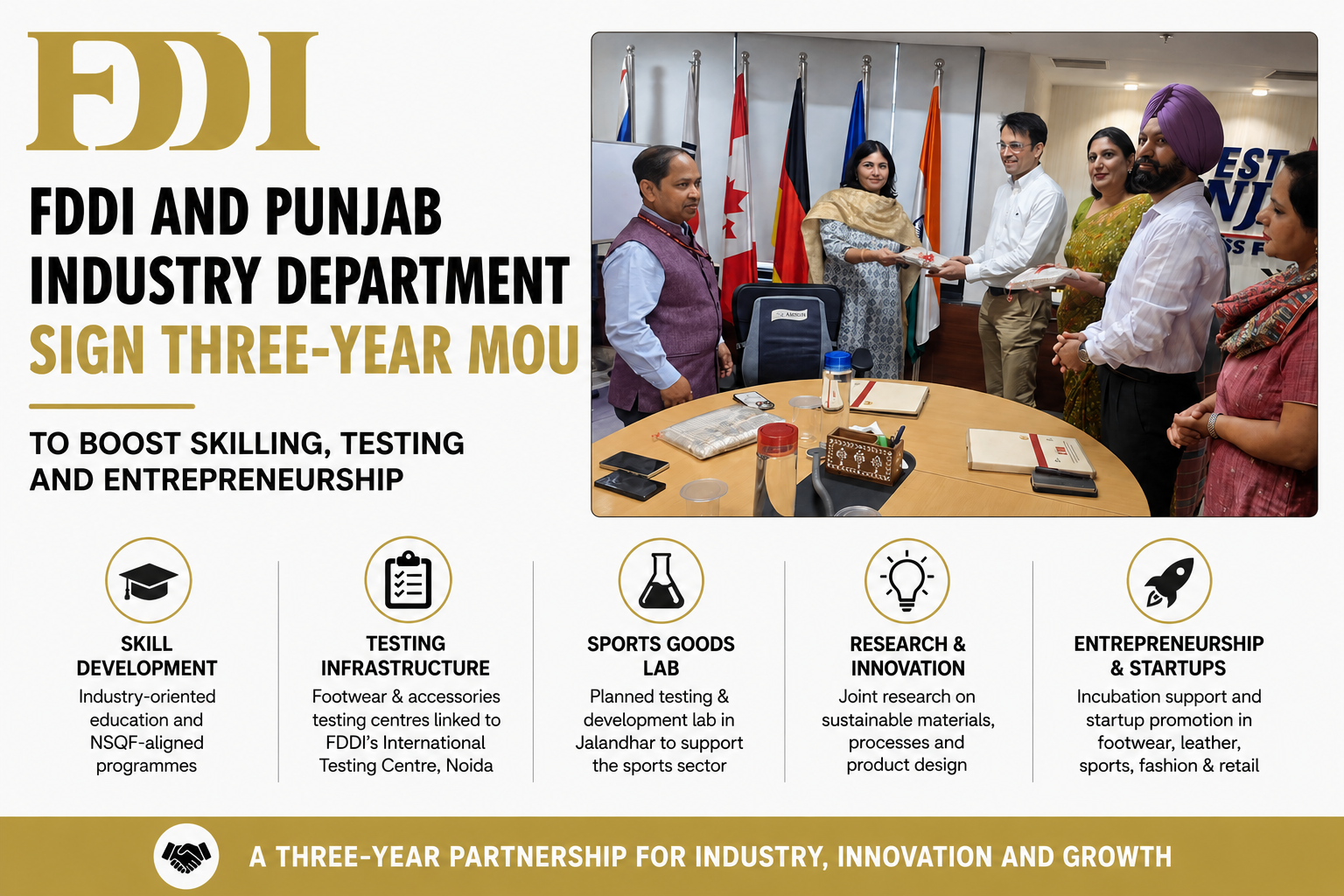
FDDI and Punjab’s Industries & Commerce department signed a three-year MoU to strengthen skilling, testing, research and startups across footwear, sports goods and allied sectors.
FDDI, Punjab Government Seal Partnership
The Footwear Design & Development Institute (FDDI) and Punjab’s Directorate of Industries & Commerce formalized a three-year Memorandum of Understanding (MoU) aimed at accelerating skill development, innovation and industrial growth in the state. The agreement was signed in Mohali by FDDI Managing Director Vivek Sharma and Director Jaspreet Singh, in the presence of Invest Punjab CEO Amit Dhaka. The signing marked a coordinated move to align education, testing and enterprise support with industry needs.
Focus on Industry-Oriented Education and Workforce Development
Under the MoU, both parties committed to design and deliver industry-oriented higher education and advanced skilling programmes that respond to local manufacturing needs. FDDI’s Banur campus agreed to participate in state and central government schemes, including NSQF-aligned training programmes. The partners planned bridge programmes and faculty exchanges to ensure curricula remained current and closely linked to employers’ expectations.
Strengthening Testing and Quality Assurance Infrastructure
A standout component of the partnership was a clear emphasis on testing and quality assurance. The MoU provided for the establishment of footwear and accessories testing sample collection centres across Punjab, directly linked to FDDI’s International Testing Centre in Noida. Officials said these centres would reduce testing turnaround times for local manufacturers, lower logistical costs and improve product compliance for both domestic and export markets.
Plans for Sports Goods Testing Lab in Jalandhar
To support Punjab’s strong sports goods manufacturing base, the collaboration included plans to develop a sports goods testing and development laboratory in Jalandhar. The lab would enable local producers to access technical testing, material validation and performance benchmarking services without sending samples out of state. Stakeholders expected the facility to strengthen product reliability and boost the sector’s competitiveness.
Promoting Research, Innovation and Startups
The MoU also prioritized research and startup incubation. FDDI and the Directorate agreed to pursue joint research projects on sustainable materials, manufacturing processes and product design. Incubation support and startup promotion formed a core objective, with FDDI’s expertise in design-led entrepreneurship slated to guide new ventures in footwear, leather, sports goods, fashion and retail.
Curriculum Development and Faculty Exchange
As part of the collaboration, institutions will co-develop curricula that reflect real-world industry challenges and emerging technologies. Faculty exchange programmes will allow educators to spend time in industrial settings and bring practical insights back to classrooms. Officials indicated that these measures would shorten the skills gap between graduates and employers while raising the quality of talent entering the workforce.
Boosting Local Manufacturing and Exports
By combining skilling, testing and innovation, the partners expected to create tangible value for manufacturers across Punjab. Faster access to quality testing and a steady pipeline of industry-ready graduates should help local firms scale production, meet quality benchmarks and access new markets. The agreement aimed to support not only domestic supply chains but also the region’s export potential.
Implementation Timeline and Deliverables
The MoU set a three-year timeline for collaboration with specific deliverables, including the rollout of bridge programmes, establishment of sample collection centres, initiation of joint research projects and the development of the Jalandhar sports goods lab. Officials noted periodic reviews and stakeholder consultations would track progress and adapt initiatives to evolving industry needs.
Stakeholder Reactions
Industry representatives and educational leaders welcomed the MoU as a practical step toward strengthening Punjab’s manufacturing ecosystem. Invest Punjab’s involvement underscored the state’s commitment to fostering industry-academic partnerships that generate jobs and support startups. FDDI’s leadership highlighted the institute’s readiness to expand regional services and technical assistance.
Conclusion: A Foundation for Long-Term Growth
The FDDI–Punjab MoU aimed to create an integrated model linking education, testing, research and entrepreneurship to industry outcomes. By addressing skill development and quality infrastructure together, the partnership sought to deliver long-term benefits for footwear, sports goods and allied sectors—helping manufacturers improve product standards, accelerate innovation and grow markets.
#FDDI #PunjabIndustry #Skilling #TestingInfrastructure #SportsGoods #Footwear #Entrepreneurship #Incubation #NSQF #Innovation