








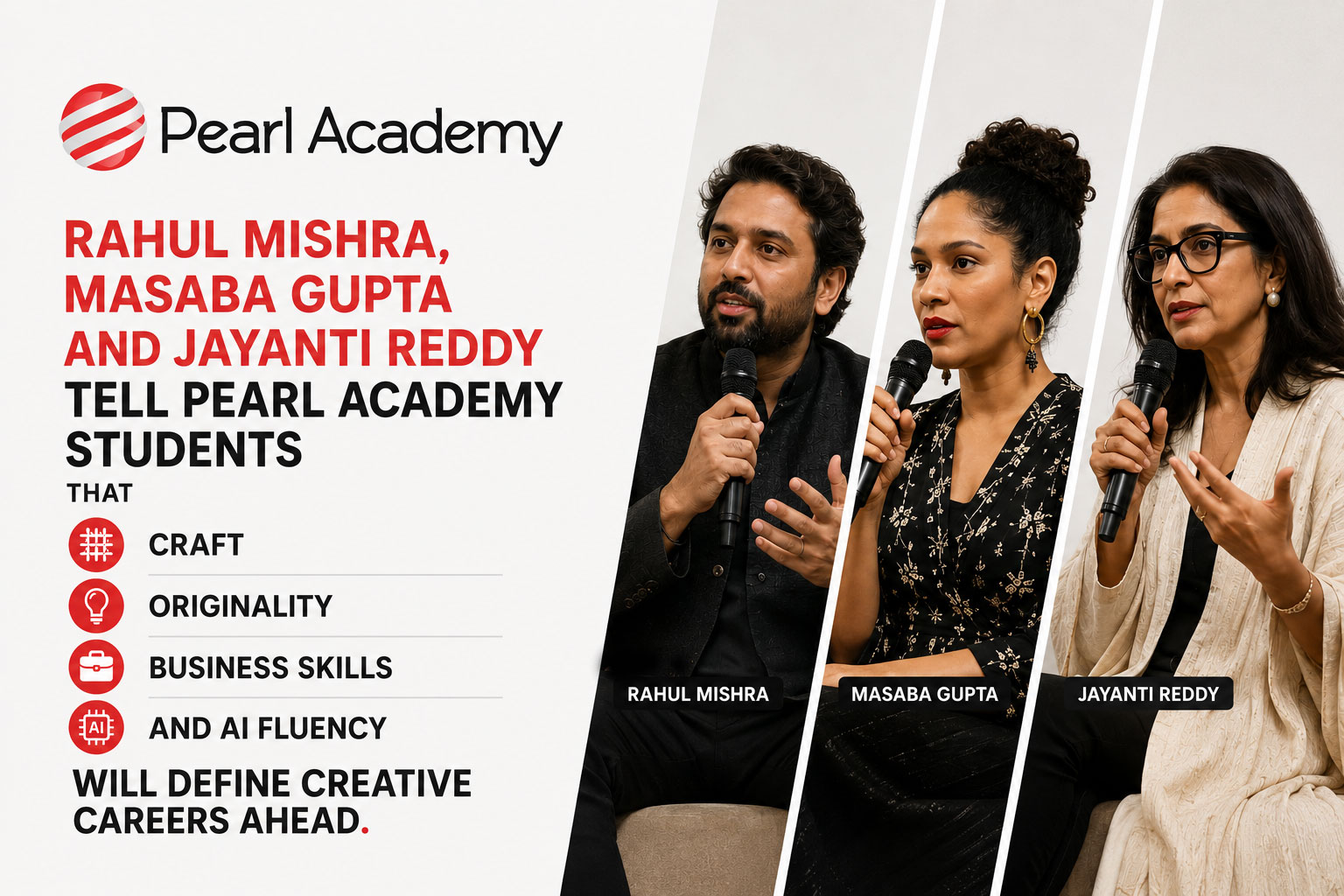
Rahul Mishra, Masaba Gupta and Jayanti Reddy tell Pearl Academy students that craft, originality, business skills and AI fluency will define creative careers ahead.
A Conversation on Human + Artificial Intelligence
Pearl Academy hosted a compelling session in its Global Icons Series where three leading creative entrepreneurs and designers – Rahul Mishra, Masaba Gupta and Jayanti Reddy – shared candid insights about the skills necessary for creative careers in an AI-driven world. The event, aimed at bridging classroom learning with industry realities, framed AI as a collaborator rather than a replacement and stressed the continuing value of human intelligence in design.
Why Craft and Originality Still Matter
Rahul Mishra, internationally renowned for bringing Indian craft to the Paris Haute Couture calendar, told students that AI can amplify creativity but cannot substitute craftsmanship. He urged students to deepen hands-on skills and preserve the human element in making: “AI is simply another assistant, faster and wider in perspective. But the physical making, the craftsmanship, the human hand, that remains irreplaceable.” Mishra encouraged attendees to use AI for research, testing concepts and expanding viewpoints while investing time in perfecting techniques that remain uniquely human.
Embracing AI to Amplify Creative Potential
Masaba Gupta presented a pragmatic view: AI will open productivity and creative opportunities for those who learn to use it. She framed AI adoption as a competitive necessity: “AI will not replace you. It will replace the person who doesn’t embrace AI.” Masaba asked students to sharpen their conceptual thinking so they can translate AI’s speed into better creative decisions. Her message blended optimism with urgency – technology expands potential but requires human judgment to realize it.
Business Discipline: The Often-Missed Skill
Jayanti Reddy focused on the operational realities of sustaining a creative business. Tracing her brand’s growth from a lone tailor to a major luxury bridal label, she explained that creative success depends heavily on systems, teams and discipline. “I spend only ten per cent of my time creating today. The other ninety per cent is business,” she said, urging designers to develop entrepreneurial skills, build scalable processes and value long-term sustainability over momentary flashes of style.
Main Highlights of the Event
- Candid panel discussion featuring personal career stories and practical advice.
- Live Q&A where students questioned the panellists on AI tools, brand building and craft preservation.
- Actionable takeaways on balancing creativity with business strategy and technological fluency.
- Emphasis on craft-led design, with examples from Rahul Mishra’s couture practice.
- Masaba’s examples of rapid product cycles and how AI streamlines ideation to production.
- Jayanti’s insights on workforce management, quality control and artisan partnerships.
- Networking opportunities between students and industry leaders for internships and mentorships.
- Pearl Academy’s AI-integrated curriculum referenced as a model for preparing future-ready professionals.
- Messages underscoring resilience, adaptability and lifelong learning.
- Calls to treat AI as a collaborator, not a threat.
Pearl Academy’s Human Intelligence + AI Philosophy
The conversation reinforced Pearl Academy’s academic shift toward a Human Intelligence + Artificial Intelligence model. Aditi Srivastava, President of Pearl Academy, framed the session as evidence of the institute’s direction: integrating AI literacy within creative education prepares students to be Domain Ready, AI Ready, Life Ready and Future Ready. The academy’s partnership with OpenAI and curricular changes – where over one-third of courses include AI components – featured prominently as practical steps to equip students with generative AI tools and workflows.
Student Engagement and Relevance
Students engaged actively throughout the session, bringing questions that ranged from technical tool choices to ethical concerns and career planning. Several attendees said they felt reassured that AI’s rise does not negate the need for deep craft skills or sound business thinking. The panellists encouraged students to use the academy’s resources – incubators, labs and mentorship programs – to experiment, build prototypes and launch entrepreneurial projects.
Practical Lessons for Creative Careers
Across the session, three practical themes emerged: preserve and elevate craft, embrace AI for productivity and insight, and build the business systems that allow creativity to scale. Panelists advised students to cultivate curiosity, cross-disciplinary fluency and resilience. They framed failure as an essential part of learning and recommended hands-on experimentation with both artisanal processes and AI tools.
Looking Ahead
The Global Icons Series event left students with an optimistic, action-oriented view of the future. Rather than fearing displacement, the panellists encouraged the next generation to combine imagination, craftsmanship and technological fluency to create unique value. By situating AI as an accelerant and underscoring the enduring importance of human judgment, Pearl Academy’s session charted a roadmap for creative careers that balances tradition with innovation.
#PearlAcademy #RahulMishra #MasabaGupta #JayantiReddy #AIFashion #CreativeCareers #Craftsmanship #DesignEntrepreneurship #HumanPlusAI #FashionEducation
Disclaimer
The information in this article is based on available public sources and official statements as of the time of publication. While we aim for accuracy, we do not guarantee completeness or correctness. We advise readers to verify key details from official sources before making any decisions. The website (fashionsamvaad.com) is not liable for any loss or damage arising from the use of this content. The authors are also not responsible for any such loss or damage.