








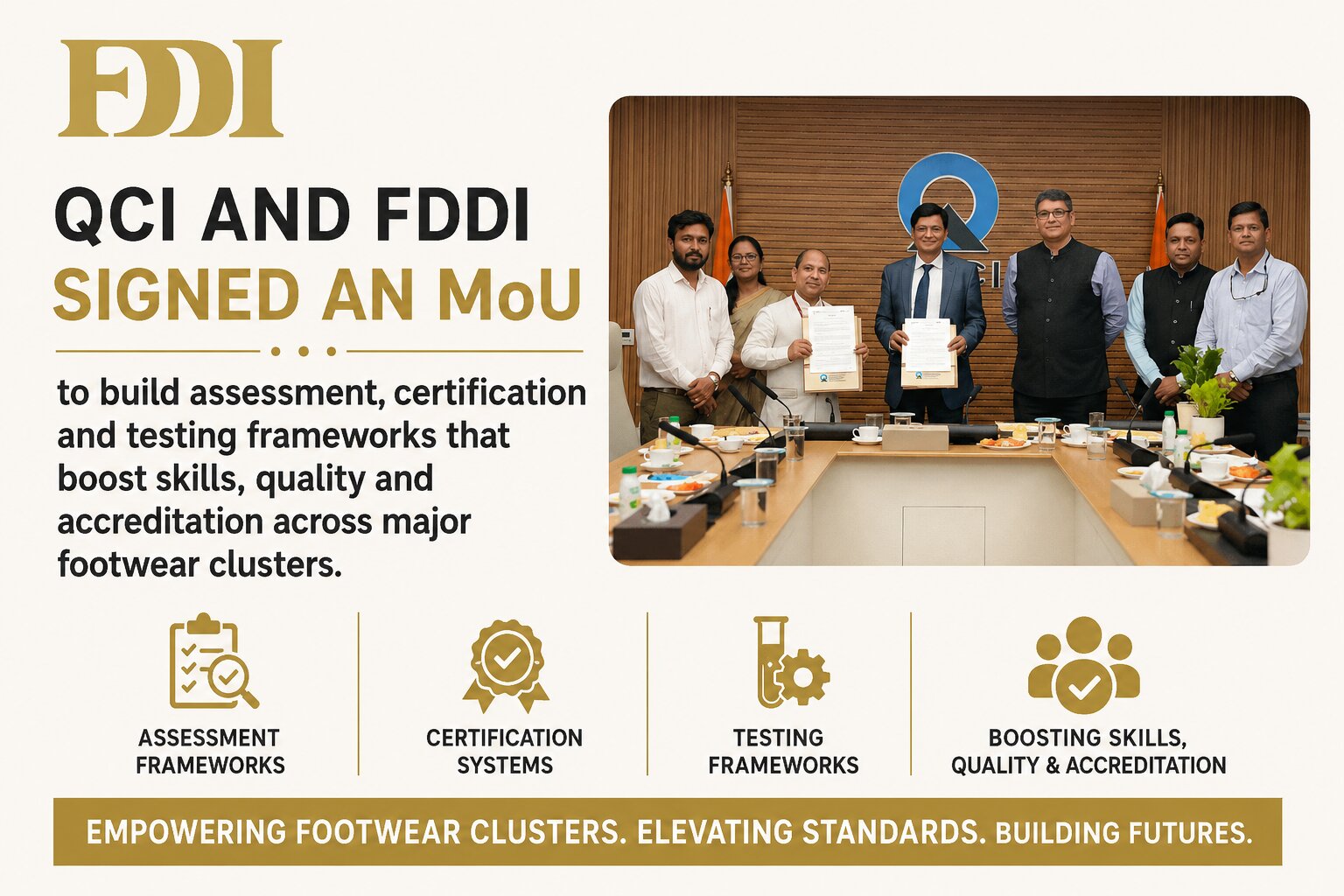
QCI and FDDI signed an MoU to build assessment, certification and testing frameworks that boost skills, quality and accreditation across major footwear clusters.
QCI and FDDI sign strategic MoU
The Quality Council of India (QCI) and the Footwear Design and Development Institute (FDDI) signed a Memorandum of Understanding to reinforce the quality, testing, accreditation and skilling ecosystem across India’s leather and footwear sector. The agreement, announced on 12 June 2026, commits both organisations to develop practical, cluster-specific programmes that raise workforce capabilities, expand testing access and institutionalise personal certification for workers and professionals.
Goals and scope of the partnership
The MoU sets out to create a multi-level assessment and certification framework for footwear workers, build capacity for MSMEs, and support laboratory accreditation and testing infrastructure. The initiative targets major footwear hubs – including Agra, Bahadurgarh, Ranipet, Chennai, Calicut and Kanpur – and aims to translate quality principles into measurable outcomes across the value chain, from shop-floor operators to industry supervisors and managers.
Role of QCI
QCI will provide technical guidance on accreditation principles, quality management systems and applicable national and international standards. The council will conduct awareness campaigns for MSMEs on quality, testing and government schemes, and contribute to joint monitoring mechanisms. QCI will also support research activities, white papers and case studies to document best practices and assess impact.
Role of FDDI
FDDI will lead cluster-specific skilling and training programmes tailored to local industry needs. Its responsibilities include mapping existing testing and calibration laboratories, identifying gaps in lab access, and supporting the creation of sample collection centres in underserved clusters. FDDI will develop knowledge resources, conduct training for supervisors and technicians, and implement Recognition of Prior Learning (RPL) pathways to formally certify semi-skilled and experienced workers.
Multi-level worker assessment and RPL pathways
A central element of the collaboration is the design of a multi-level worker assessment and personal certification framework. This will recognise competencies across different job roles and skill levels, and offer RPL routes for workers who possess on-the-job expertise but lack formal qualifications. The framework intends to make certification more accessible, credible and useful for career advancement, while also supplying industry with standardized measures of workforce competence.
Strengthening testing and accreditation
The partnership will intensify efforts to improve laboratory access and accreditation. FDDI will map laboratory infrastructure and help set up sample collection points where testing services are scarce. QCI will guide laboratories through accreditation processes and quality management system implementation. Together they will work to ensure that testing services meet required standards, enabling MSMEs to verify product quality and comply with regulations and buyer requirements.
Benefits for MSMEs and clusters
Cluster-specific programmes will help MSMEs adopt quality management practices, access testing services, and benefit from targeted training modules. By aligning skills development with industry needs, the partnership aims to enhance productivity, reduce defects, and improve market competitiveness. Improved accreditation and testing will also support exports and open doors to newer markets that demand certified quality and traceability.
Research, monitoring and knowledge creation
QCI and FDDI plan to develop joint monitoring frameworks, research studies, white papers and case studies that capture lessons learned and measure programme outcomes. These knowledge outputs will support continuous improvement and help policymakers and industry stakeholders replicate successful interventions across other manufacturing clusters.
Signatories and institutional backing
The MoU was signed by Shri Chakravarthy T. Kannan, Secretary General of QCI, and Shri Vivek Sharma (IRS), Managing Director of FDDI. The partnership aligns with national objectives to build globally competitive, quality-driven and future-ready manufacturing ecosystems, particularly for MSMEs and the workforce in the leather and footwear sector. QCI, an autonomous body established by the Government of India, and FDDI, under the Ministry of Commerce and Industry, bring complementary mandates in third-party assessment and skill development.
Implementation roadmap and next steps
Immediate actions under the MoU will include conducting a baseline mapping of skills and laboratory infrastructure in priority clusters, piloting multi-level assessments and RPL drives, and launching awareness campaigns for MSMEs. FDDI will roll out training schedules and begin setting up sample collection centres, while QCI will start technical outreach to laboratories and industry bodies. Both organisations will monitor progress and refine interventions based on cluster-specific feedback.
Long-term impact and vision
By combining QCI’s accreditation expertise with FDDI’s skilling and industry networks, the partnership aims to create sustainable improvements in product quality, worker credentials and cluster competitiveness. With standardized certification and better access to accredited testing, footwear clusters can better meet buyer expectations, reduce rejections, and scale operations. For workers, RPL and structured assessments can open pathways to higher wages, mobility and dignified careers.
#QCI #FDDI #FootwearIndustry #LeatherSector #Skilling #Certification #QualityAssurance #RPL #ClusterDevelopment #TestingAndAccreditation