









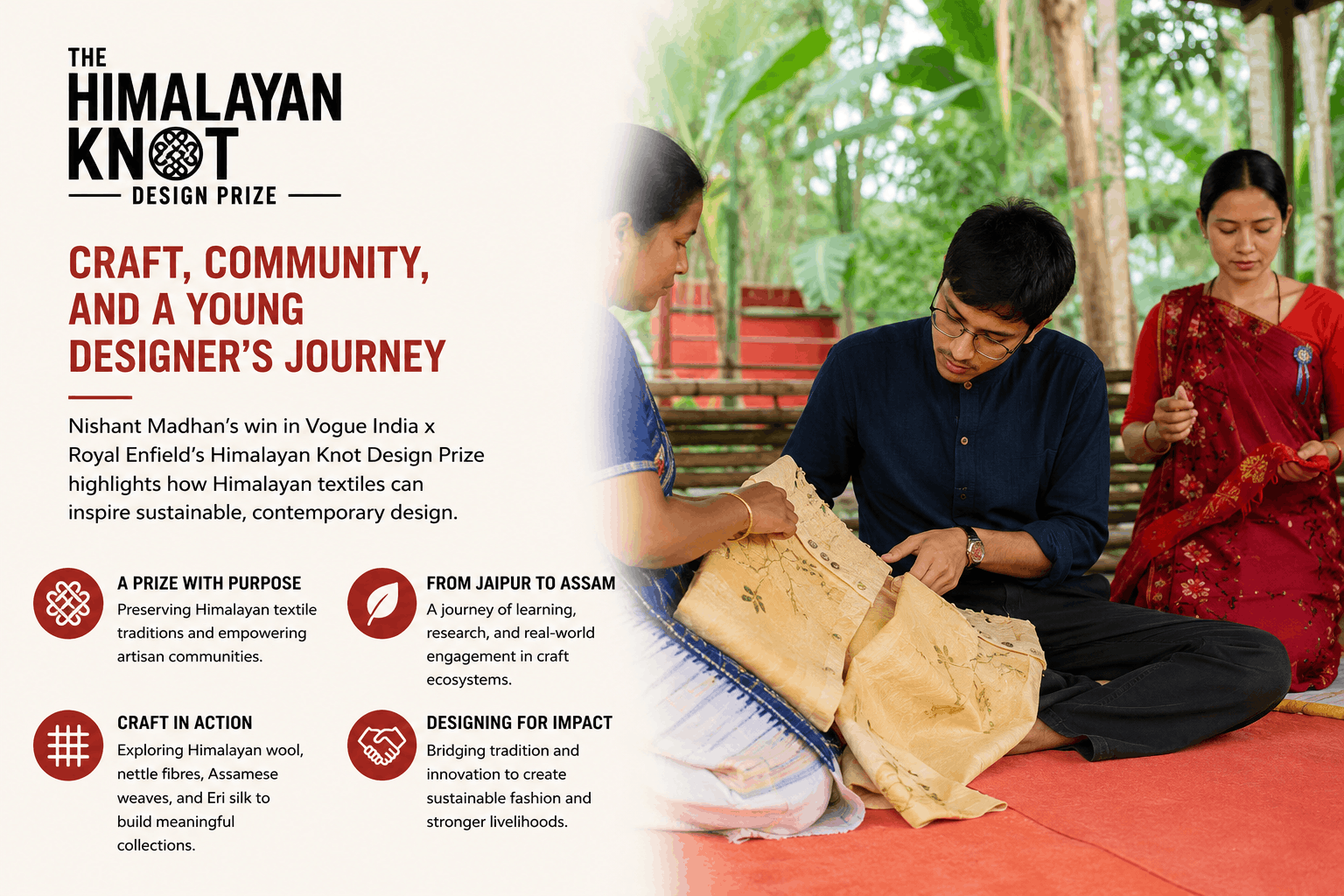
Nishant Madhan’s win in Vogue India x Royal Enfield’s Himalayan Knot Design Prize highlights how Himalayan textiles can inspire sustainable, contemporary design.
A Prize With Purpose
The Himalayan Knot Design Prize sits within Royal Enfield Social Mission’s textile conservation programme, which aims to preserve and promote the craft traditions of the Indian Himalayan region. Each season invites designers and students from across the country to present ideas rooted in sustainability and craft. The initiative is built not only to spotlight heritage textiles, but also to create real opportunities for collaboration with artisan communities.
For Season 2, the jury selected Nishant Madhan for the internship after several rounds of evaluation. The panel included Vogue India’s Rochelle Pinto, fashion entrepreneur Pernia Qureshi, designer Suket Dhir, craft advocate Laila Tyabji, and Vigyat Singh of the Eicher Group Foundation. Their selection reflects the prize’s growing credibility as a platform that links fashion education, industry mentorship, and craft-led innovation.
Early Interest In Textiles
Madhan’s interest in craft began long before the competition. Growing up in Jaipur, he was surrounded by crocheted doilies, lace covers, and hand-knitted garments, and he watched the women in his family spend evenings knitting, embroidering, and crocheting together. He was drawn to those practices early, even when they were seen as unconventional for boys. That early curiosity later shaped his choice to study textile design professionally, with a focus on craft research.
His design process for the final jury presentation reflected that background. He created swatches using Himalayan wool and nettle fibres, showing an interest in weaving methods, material culture, and textile experimentation. For Madhan, the prize aligned closely with his values because it offered a chance to engage with different landscapes through culture, craft, and community. Winning the internship, he says, expanded his horizons.
Journey To Assam
The next phase of the project took Madhan to Assam, where he joined Royal Enfield Social Mission’s Himalayan Knot capsule collection. The collection is a collaboration between designer Harsh Agarwal’s label Harago and Assam-based Saneki Weaves. Its purpose is not just to produce contemporary clothing and accessories, but to strengthen local craft capabilities through design exchange and skill-building.
As part of this process, artisans are introduced to tailoring, pattern making, and contemporary design approaches so they can eventually manage the full production cycle more independently. For this collection, Eri silk and embroidery were added as new techniques, translating Assamese textile heritage into a modern product range. This model shows how design can function as a bridge between tradition and future livelihoods.
Learning On The Ground
Madhan’s preparation began in Jaipur in early January, where he spent weeks researching the project. A meeting with Harsh Agarwal helped shape the collection’s design language, especially through discussions on materials, yarn counts, and colour palettes. He then met the Royal Enfield Social Mission team in Gurugram to understand the organisation’s approach to craft preservation and community engagement.
After returning briefly to Jaipur to refine his proposal, Madhan travelled to the Northeast for the first time. That journey marked an important step in the project, because it moved the design process from research and planning into direct engagement with place and people. The article leaves readers with a sense of anticipation, suggesting that the wider story of the collection will continue to unfold.
Why It Matters
The Himalayan Knot Design Prize stands out because it treats fashion as a collaborative practice rather than a purely aesthetic exercise. It places students and emerging designers inside real craft ecosystems, where learning happens through conversation, observation, and making. Madhan’s journey is a reminder that contemporary design can stay relevant while still respecting the labour and knowledge embedded in traditional textiles.
The initiative also points toward a broader shift in fashion education, where sustainability is no longer treated as a side note but as a core design value. By bringing Himalayan craft into dialogue with young designers, the project creates space for both preservation and reinvention. That balance is what gives the prize its lasting significance.
#TheHimalayanKnot #NishantMadhan #VogueIndia #RoyalEnfield #SustainableFashion #TextileConservation #AssameseWeaves #EriSilk #CraftInnovation #IndianCraft