









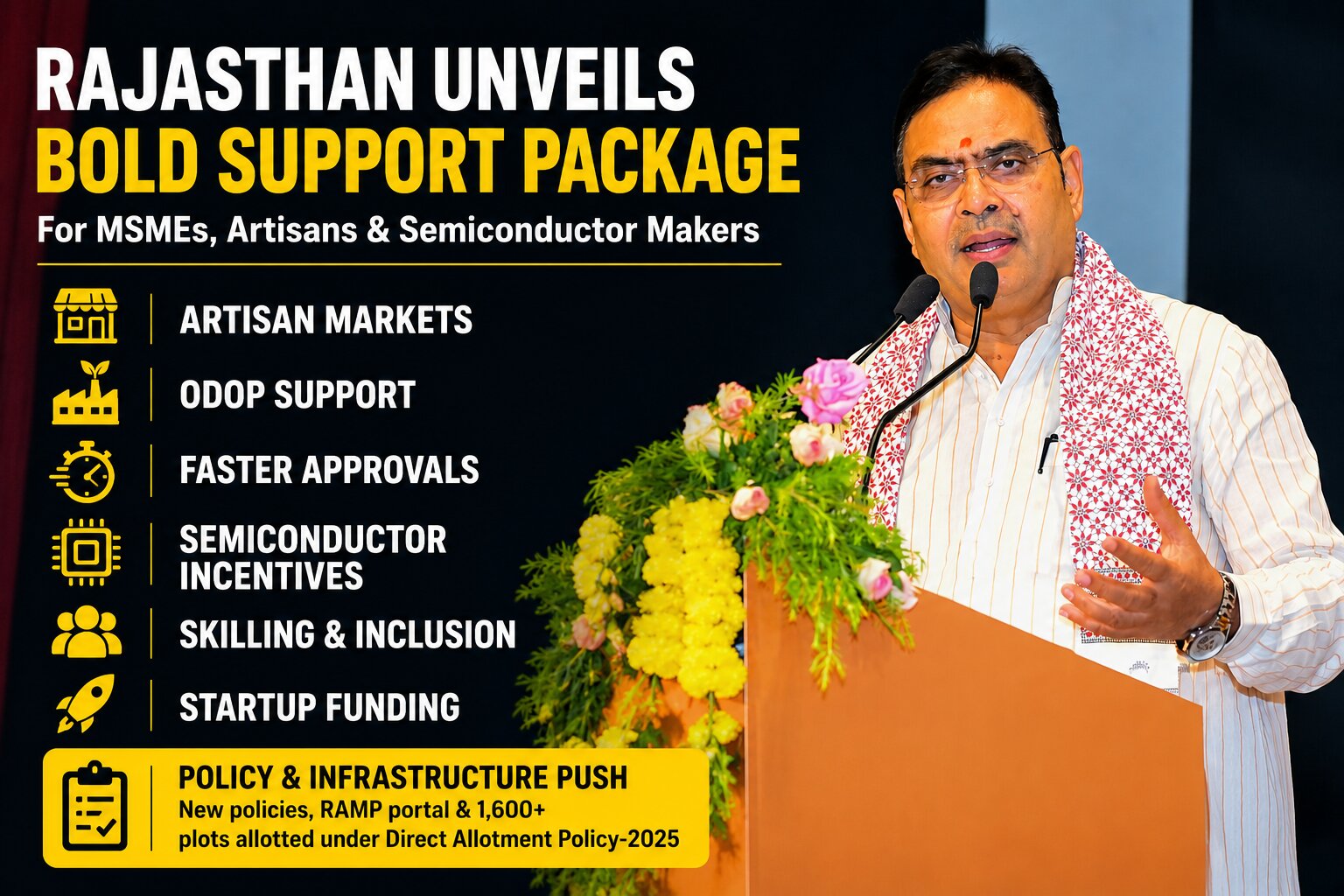
Rajasthan launched targeted measures to boost MSMEs, artisan markets, startups and electronics manufacturing, cutting approval times and expanding financial and training support.
Rajasthan Chief Minister Bhajanlal Sharma announced a comprehensive package of reforms and incentives aimed at accelerating growth in the state’s micro, small and medium enterprises (MSMEs), supporting artisans, and attracting electronics and semiconductor investment. Delivered at a state function marking International MSME Day, the announcements emphasize faster approvals, targeted funding, market linkages and skill support to convert policy intent into tangible business growth.
Artisan markets under PPP to showcase local crafts
The state will develop artisan markets for handicraft workers, weavers and micro enterprises under a public-private partnership (PPP) model. In the first phase, the government established markets at Pushkar, Nathdwara, Jaisalmer and Alwar. These hubs will provide artisans with organized retail spaces, improved market access and branding opportunities to reach domestic and tourist customers. The move targets both employment generation in rural craft clusters and preservation of traditional skills by connecting producers to steady demand.
One District One Product (ODOP) backing for processing units
Under the One District One Product (ODOP) initiative, the government announced financial assistance for processing units linked to identified species and plants through the Panch Gaurav Yojana. This measure will enable value-addition near production hubs, reduce post-harvest losses, and increase farmers’ and micro-enterprises’ incomes by supporting processing, packaging and market-ready formats for local products.
Easier approvals and faster industrial setup
To make Rajasthan more business-friendly, the state streamlined industrial approvals. Land-use approval for urban MSME units now takes 30 days, down from 60 days. Overall industry setup approvals have been cut dramatically from 120 days to 30 days. These shortened timelines aim to remove administrative bottlenecks, encourage faster project rollouts and make the state more attractive to small and medium investors seeking predictable timelines.
Incentives for electronics and semiconductor manufacturing
Recognizing the strategic importance of electronics and semiconductors, the government lowered the minimum investment threshold under the Rajasthan Investment Promotion Scheme (RIPS)-2024 to Rs 15 crore for select manufacturing components. Projects covered by the Centre’s Electronics Component Manufacturing Scheme (ECMS) can now stagger investments across five phases instead of the earlier three under RIPS-2024. These changes reduce entry barriers and allow more flexible capital deployment, which should help secure anchor investments and build manufacturing ecosystems.
Skills allowance and inclusive training measures
The state raised the monthly skill development and training allowance for women and persons with disabilities working in the electronics and semiconductor sector from Rs 4,000 to Rs 6,000. This increase supports inclusive participation in higher-value manufacturing and helps employers retain trained workers while reducing the financial burden on trainees.
Startup support and venture funding
Rajasthan also committed fresh funding to the startup ecosystem. Twenty-five startups will receive financial assistance this year through the Rajasthan Venture Capital Fund. The injection of early-stage capital aims to scale promising innovations, encourage local entrepreneurship and create linkages between startups and established industry players in the state.
RAMP portal and policy launches
During the program, the chief minister launched the Rajasthan Industrial Development Policy, an ODOP coffee table book and the RAMP (Raising and Accelerating MSME Performance) portal. These digital and policy tools will centralize information, provide easier access to scheme benefits, and track performance metrics to ensure accountability and follow-through on announced measures.
Land allotment and direct allotment progress
Sharma highlighted that more than 1,600 industrial plots had been allotted over the past year under the Direct Allotment Policy-2025. The availability of land combined with faster approvals and tailored incentives forms a coordinated push to attract manufacturing units and ancillary suppliers to set up operations in Rajasthan.
Immediate benefits and expected impact
At the event, the government distributed cheques worth over Rs 13 crore in loans, grants and subsidies to beneficiaries under various state schemes, demonstrating immediate disbursement and benefit flow. Collectively, the measures are expected to strengthen artisanal incomes, expand MSME capacity, accelerate local value chains, and position Rajasthan as a competitive destination for electronics and semiconductor investments.
Conclusion
Rajasthan’s package mixes quick administrative wins-shorter approval timelines and land allotments-with longer-term strategic bets-semiconductor incentives, skill stipends, market infrastructure and startup funding. If implemented effectively, these steps can boost employment, deepen manufacturing ecosystems and help craft clusters graduate from informal supply to market-ready enterprises.
#RajasthanMSMEs #ArtisanMarkets #OneDistrictOneProduct #SemiconductorIncentives #ElectronicsManufacturing #StartupFunding #RajasthanInvestment #SkillDevelopment #RAMPportal #DirectAllotment
Disclaimer
The information in this article is based on available public sources and official statements as of the time of publication. While we aim for accuracy, we do not guarantee completeness or correctness. We advise readers to verify key details from official sources before making any decisions. The website (fashionsamvaad.com) is not liable for any loss or damage arising from the use of this content. The authors are also not responsible for any such loss or damage.