







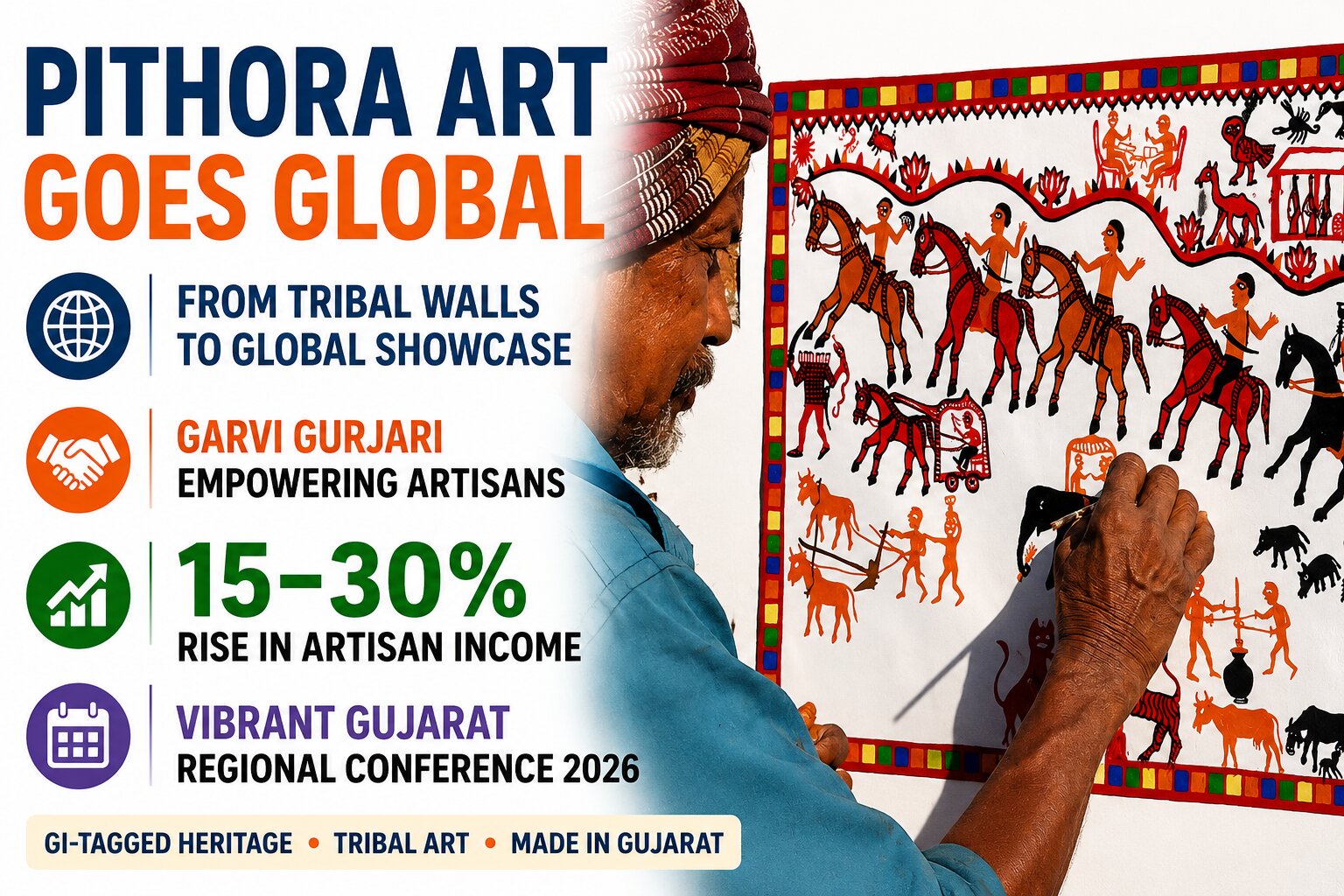
Pithora art moved from tribal mud walls to a global showcase as Garvi Gurjari backed artisans, raised incomes, and highlighted Gujarat’s living heritage.
Pithora Art Finds a New Canvas
Pithora art, once painted only on the mud walls of tribal homes for ritual purposes, has now stepped into a wider public spotlight. At the Vibrant Gujarat Regional Conference in Vadodara, the ancient craft took center stage as part of Gujarat’s push to promote GI-tagged products and support local artisans. The event, held from June 29 to July 3 at GSFC University, showcased how a traditional art form can grow into a source of dignity, identity, and income.
The story of Pithora art is also a story of cultural survival. Practised by the Rathwa, Bhil, and Bhilala communities in Chhotaudepur, Vadodara, and Panchmahal, the paintings traditionally served as sacred expressions of harmony between humans, nature, and the divine. Today, the same visual language is finding new audiences, new buyers, and new relevance in a fast-changing market.
Garvi Gurjari’s Support
The Gujarat State Handloom and Handicrafts Development Corporation, through its Garvi Gurjari brand, has played a major role in this transformation. The organisation has supported artisans by directly purchasing artworks, arranging design workshops, offering transport and stall subsidies, and helping them take part in exhibitions and live demonstrations. These efforts gave the craft a stronger market presence while keeping its traditional character intact.
Over the past five years, GSHHDC purchased artwork worth Rs 6.2 lakh directly from Pithora artisans, according to the official release cited in the report. That support has translated into a steady 15-30 per cent rise in artisan income, showing that heritage conservation and livelihood growth can go hand in hand. For many families, this shift has reduced dependence on village-only work and opened the door to wider exposure.
Voices From The Craft
Artisan Naran Rathwa said the workshops, live demonstrations, and fairs organised under Garvi Gurjari helped expand both income and opportunity. He explained that earlier, his livelihood depended only on work available in the village, but exposure through the brand changed that reality. His experience reflects a broader change across tribal craft communities, where traditional skills are increasingly linked to market access.
Padma Shri awardee Paresh Rathwa called Garvi Gurjari a source of pride for Gujarat. He said the organisation carried the heritage of his tribal community and the fragrance of its soil to audiences far beyond the state. He also noted that the modern presentation of the craft has drawn younger people back toward their culture, which is important for long-term preservation.
Heritage With Market Value
The event highlighted a key lesson: traditional art survives best when communities can earn from it with dignity. Pithora art is no longer limited to ritual walls; it has become a product, a symbol, and a cultural message that can travel across markets. Garvi Gurjari’s role shows how public support can turn a local craft into a sustainable livelihood without stripping away its meaning.
The Pithora paintings displayed at the conference also showed how artisans keep the tradition alive while allowing room for creativity. Officials said every painting follows symbolic conventions, but artists still use different colour palettes, borders, and contemporary motifs, making each work distinct. That balance between continuity and innovation gives the craft both authenticity and commercial appeal.
A Lasting Impact
Though the event is now over, its message continues to matter. The showcase at the Vibrant Gujarat Regional Conference demonstrated that cultural heritage can thrive when it is given the right platform, policy support, and public attention. It also showed how state-backed initiatives can help tribal artisans move from invisible labour to visible creative entrepreneurship.
For Gujarat, the bigger achievement is not just the display of a beautiful art form, but the strengthening of an ecosystem around it. By linking Pithora art with exhibitions, income growth, and younger audiences, Garvi Gurjari has helped turn a sacred tradition into a living, evolving market asset. The result is a model that other craft communities may look to for inspiration.
#PithoraArt #GarviGurjari #VibrantGujarat #TribalArt #GItag #Handicrafts #Artisans #CulturalHeritage #SustainableLivelihood #MadeInGujarat
Disclaimer
The information in this article is based on available public sources and official statements as of the time of publication. While we aim for accuracy, we do not guarantee completeness or correctness. We advise readers to verify key details from official sources before making any decisions. The website (fashionsamvaad.com) is not liable for any loss or damage arising from the use of this content. The authors are also not responsible for any such loss or damage.