









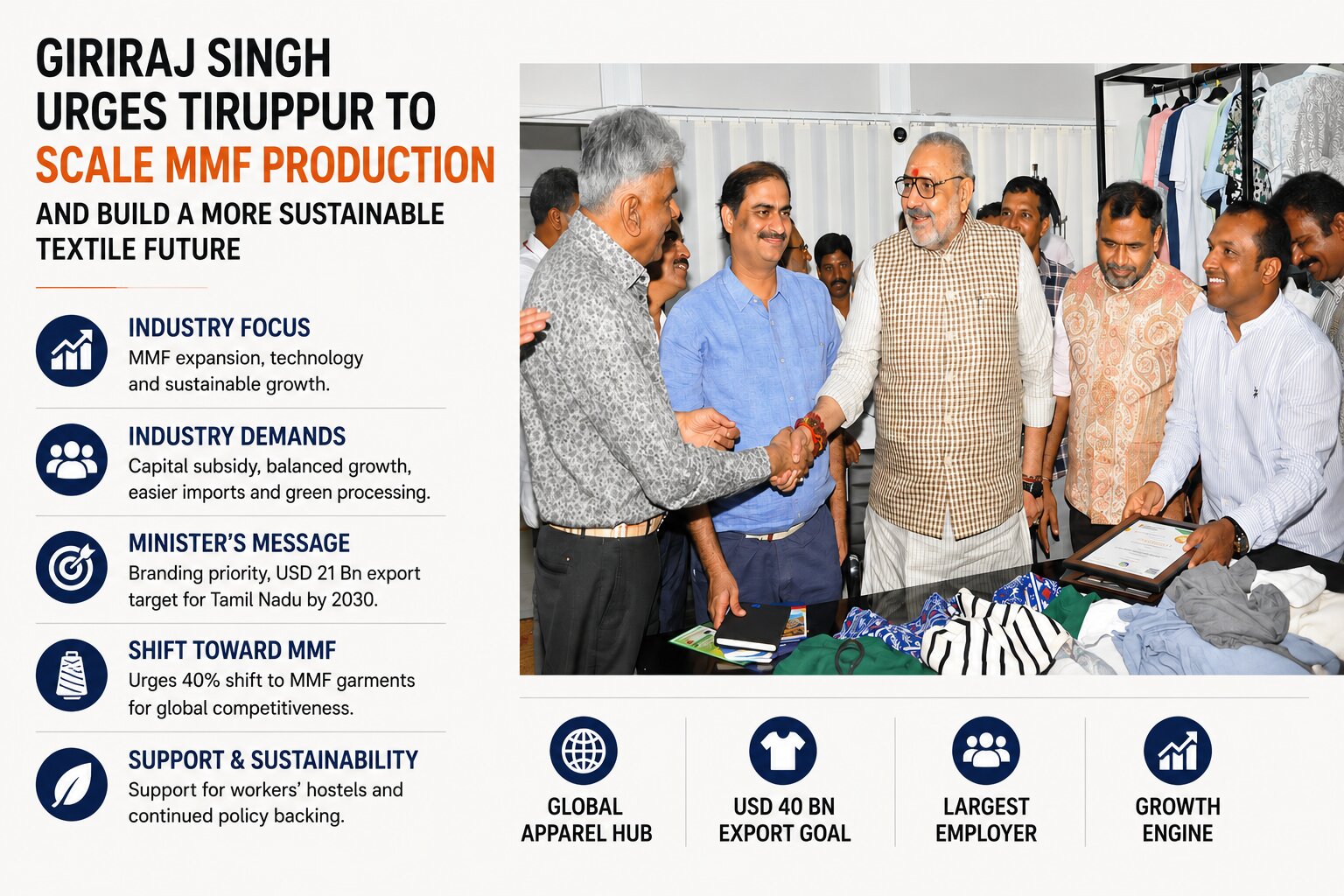
During his Tiruppur visit, Textile Minister Giriraj Singh backed MMF expansion, sustainable production, and stronger policy support for India’s apparel export growth.
Tiruppur Under the Spotlight
Union Textile Minister Shri Giriraj Singh’s visit to Tiruppur brought fresh attention to one of India’s most important apparel hubs. The minister toured Nethaji Apparel Park, interacted with industry representatives, and attended an exporters’ meeting organised by the Tiruppur Exporters’ Association. The visit highlighted both Tiruppur’s manufacturing strength and the policy push needed to secure its next phase of growth.
Tiruppur has already built a global reputation as a knitwear cluster, but the industry now wants to move faster on diversification, technology, and sustainability. The minister’s visit gave the sector an opportunity to present its priorities directly to the central government.
What the Industry Asked For
During the interaction, Dr. A. Sakthivel, Chairman of AEPC, urged the government to strengthen the PM MITRA scheme by extending a 50 per cent capital subsidy for textile processing units. He also called for balanced growth between cotton and man-made fibre garments, easier fabric imports under export schemes, a Centre of Excellence for Green Processing, and broader policy support to help India achieve apparel exports of USD 40 billion, including USD 20 billion from MMF garments.
These demands reflected a larger industry strategy: Tiruppur wants to remain competitive while adapting to changing global demand. The push for MMF growth is central because international buyers are increasingly seeking performance wear, technical fabrics, and products that can compete on value as well as quality.
Minister’s Key Message
Shri Giriraj Singh praised Tiruppur’s transformation from an unorganised cluster into a globally recognised and sustainable apparel manufacturing hub. He credited the entrepreneurial ecosystem, Dr. A. Sakthivel’s leadership, and the contributions of senior textile officials for helping the region gain national and international prominence.
The minister also said that branding Tiruppur should be a national priority. He described the textile sector as the largest employment generator after agriculture and said Tamil Nadu has been assigned an apparel export target of USD 21 billion by 2030.
Shift Toward MMF
A major takeaway from the minister’s address was his call for exporters to diversify their product mix and gradually shift 40 per cent of production toward MMF garments. He argued that this move would improve global competitiveness and help India respond better to evolving market trends.
That message matched the industry’s own long-term thinking. Tiruppur’s growth model has traditionally been driven by cotton knitwear, but the next phase depends on building a stronger presence in synthetic and blended categories.
Sustainability and Support
Singh also assured the industry that both the Central and State Governments would consider support for workers’ hostel facilities and respond positively to the industry’s representations. His remarks suggested that labour infrastructure remains part of the policy discussion, not just production and exports.
The minister pointed to progress across GST collections, textile consumption, manufacturing growth, and other economic indicators over the last 12 years. By linking Tiruppur’s local performance to national economic progress, he framed the cluster as a strategic asset for India’s apparel ambitions.
Why the Visit Matters
The Tiruppur visit mattered because it connected industry realities with policy priorities. Exporters used the meeting to push for clearer support on MMF expansion, technology upgradation, and green processing, while the minister signalled that the government sees the textile sector as a major growth engine.
It also reinforced the idea that Tiruppur’s future will depend on balancing scale with sustainability. The cluster already has a strong export base, but its next leap will require investment in product diversification, infrastructure, and cleaner production systems.
What Comes Next
The meeting ended with assurances, but the real test lies in execution. If the government follows through on policy support and the industry expands MMF capacity, Tiruppur could strengthen its position in global apparel markets over the coming years.
For now, the visit has set the direction: more diversification, more sustainability, and more ambition. Tiruppur’s rise has been built on entrepreneurship, and the latest engagement suggests that the cluster is preparing for a bigger and more competitive future.
#Tiruppur #GirirajSingh #Textiles #MMF #ApparelExports #SustainableGrowth #AEPC #TEA #PMMITRA #MadeInIndia
Disclaimer
The information in this article is based on available public sources and official statements as of the time of publication. While we aim for accuracy, we do not guarantee completeness or correctness. We advise readers to verify key details from official sources before making any decisions. The website (fashionsamvaad.com) is not liable for any loss or damage arising from the use of this content. The authors are also not responsible for any such loss or damage.