










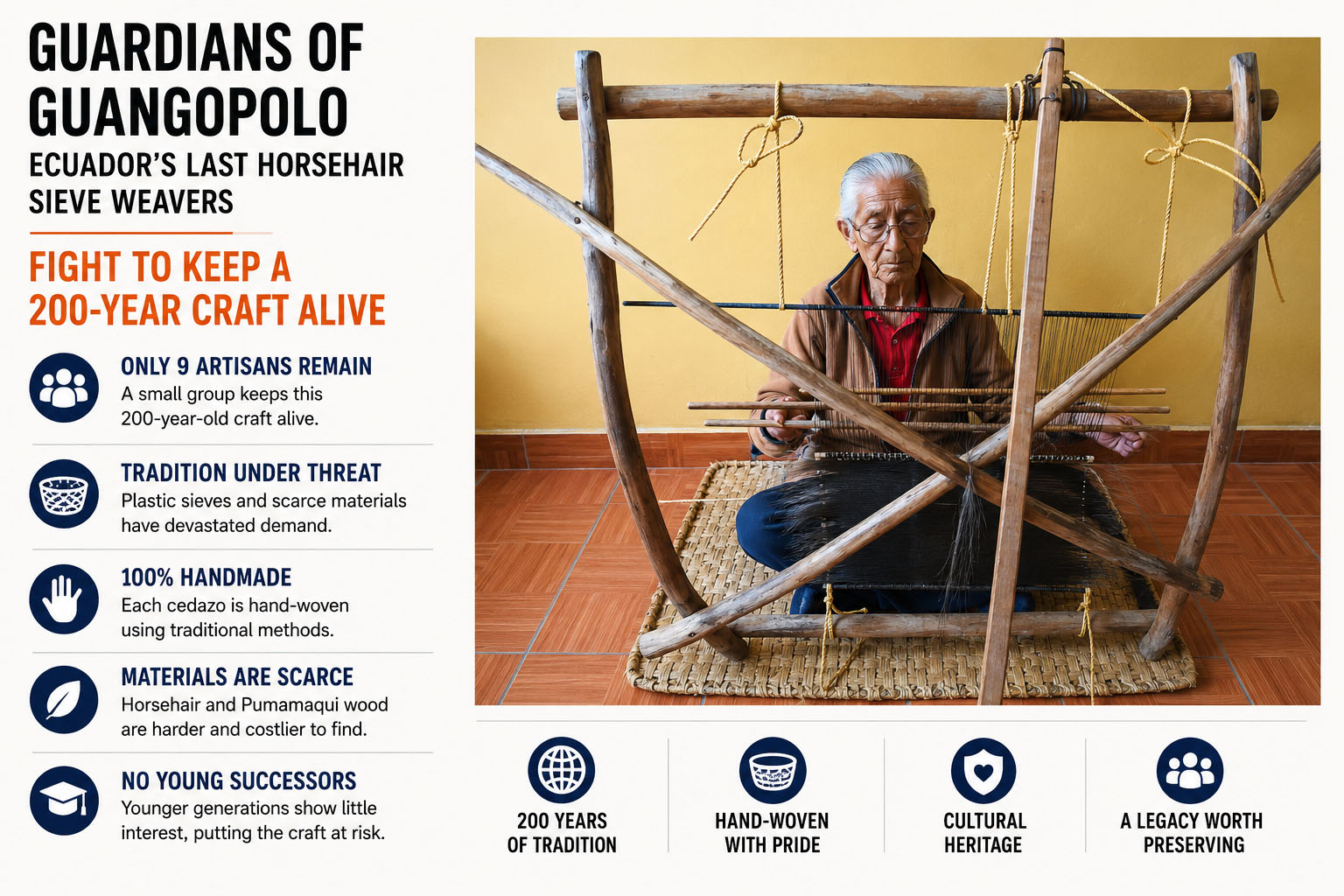
In Guangopolo, Ecuador, a handful of artisans still weave horsehair cedazos by hand, preserving a fading tradition against plastic, scarcity, and time.
A Craft Hanging By A Thread
In Guangopolo, a village east of Quito, Ecuador, a small group of artisans continues to weave horsehair sieves called cedazos with remarkable patience and pride. The craft once defined the village, but today only nine cedacero artisans remain, and the youngest among them is already 51. Their work now carries a weight far beyond daily livelihood: it represents identity, memory, and the survival of a tradition that has endured for about 200 years.
The Last Generation Of Weavers
Ligia Ipiales, 76, still sits at home separating strands from a horse’s tail and weaving them into a mesh so fine it resembles gauze. Around her, the rhythm of the old craft continues through the hands of a few determined artisans who believe they are the last generation capable of making these sieves. Guido Paucar, 51, says the village would lose part of itself if the craft vanished, because the cedazo is more than a tool; it is a symbol of Guangopolo’s history.
Why The Craft Is Fading
The decline began when cheaper plastic sieves and synthetic fabrics entered the market and replaced the traditional horsehair versions in everyday kitchens. Fifty years ago, around 500 Indigenous families earned a living from the craft, and they could sell up to 600 sieves a month. Today, sales have collapsed to about 10 a week, turning a once-living trade into a heritage object admired more than used.
Materials Are Harder To Find
Artisans also face growing difficulty in sourcing the raw materials needed for production. Horsehair has become expensive and less accessible, while the native Pumamaqui wood used for the frames is also harder to obtain. Since horses are no longer central to farming in the Andes, artisans now depend on supplies from southern Colombia and central Ecuador, where 45 kilograms of horsehair can cost around US$1,000.
How A Cedazo Takes Shape
The making of a cedazo demands precision, speed, and long practice. After washing and drying the horsehair, artisans sort it by length and stretch it across a simple wooden frame called a guanga. They then knot and weave each strand into a tight mesh, building the sieve step by step until it takes the shape of a small drum with a thin wooden rim.
A Home, A Workshop, A Memory
At the El Cedacero craft center, the remaining weavers continue working in close quarters, often cross-legged on the floor, their fingers moving so quickly that they seem to blur. The center also sells horsehair bracelets and brushes, showing how artisans have adapted their skills to survive. Yet training younger people has proven difficult, even when workshops and classes try to pass on the technique.
The Challenge Of The Future
The biggest threat to the craft is not only material scarcity but also a lack of interest from younger generations. Leonor Cuje, 57, said her mother taught her to weave when she was a child, but today younger people see the work as less attractive than professional careers. That shift has left the community with a painful reality: the knowledge still exists, but the number of hands willing to carry it forward keeps shrinking.
Why This Craft Matters
The story of Guangopolo’s horsehair sieves is about more than a disappearing product. It reflects the broader struggle many traditional crafts face when modern materials, changing economies, and shifting aspirations break the chain between generations. The artisans of Guangopolo continue weaving not just to earn money, but to defend a living cultural heritage that still speaks for their village.
Main Highlights
- Only nine cedacero artisans remain in Guangopolo.
- The craft has been part of the village for about 200 years.
- Horsehair sieves once supported around 500 Indigenous families.
- Monthly sales once reached 600 units; now artisans sell only about 10 a week.
- Cheap plastic sieves have replaced traditional horsehair versions in daily use.
- Horsehair and Pumamaqui wood are now harder and costlier to source.
- Artisans still hand-weave each sieve using traditional methods.
- Training younger generations has largely failed so far.
- The craft now survives mainly as cultural heritage.
- The artisans see their work as part of Guangopolo’s identity.
#Ecuador #Guangopolo #HorsehairWeaving #Cedazo #TraditionalCraft #Artisans #CulturalHeritage #Handicraft #DyingTrade #Preservation
Disclaimer
The information in this article is based on available public sources and official statements as of the time of publication. While we aim for accuracy, we do not guarantee completeness or correctness. We advise readers to verify key details from official sources before making any decisions. The website (fashionsamvaad.com) is not liable for any loss or damage arising from the use of this content. The authors are also not responsible for any such loss or damage.