









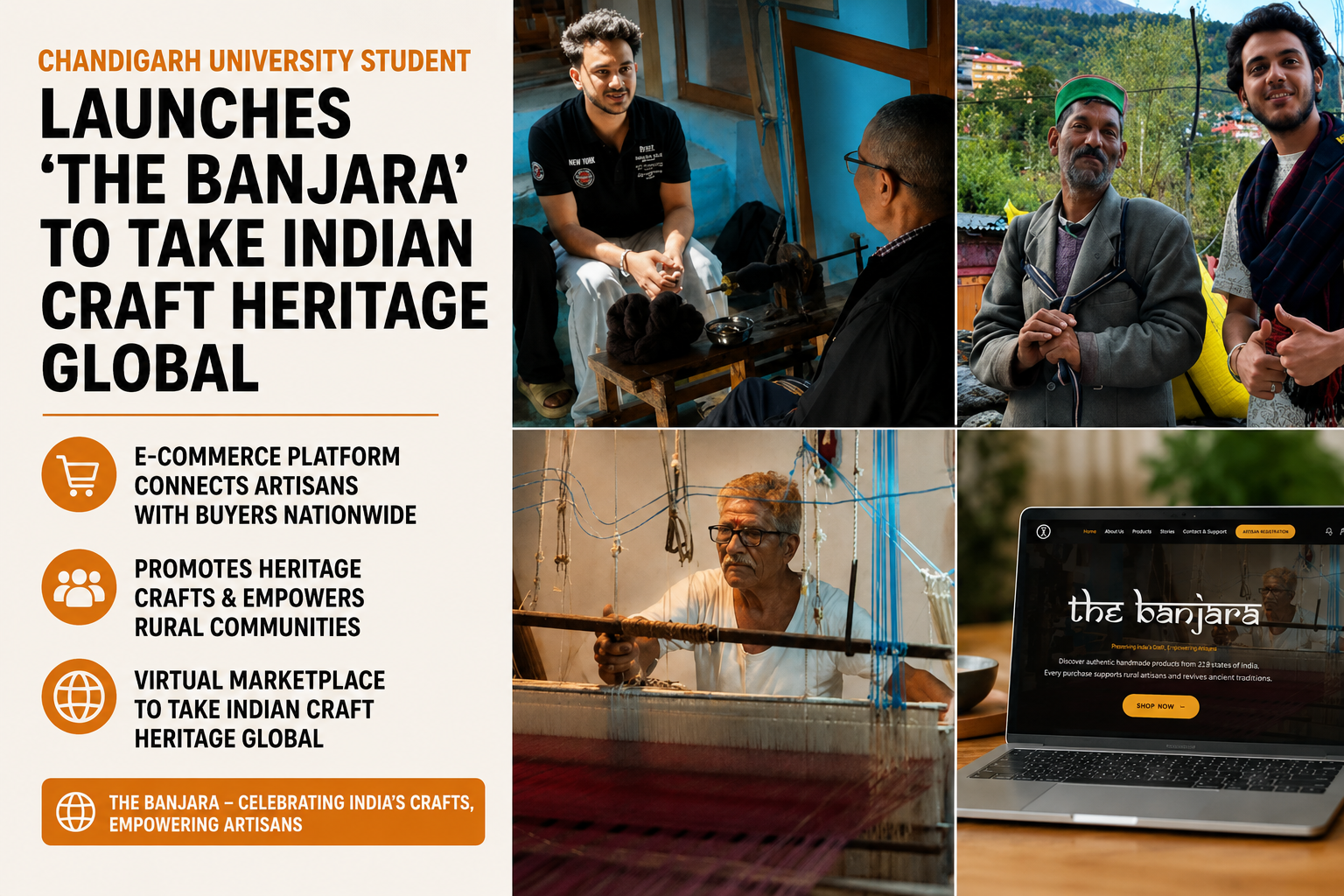
Chandigarh University’s MBA student Tanish Sharma launched e-commerce platform ‘The Banjara’ to connect Indian artisans with buyers nationwide, promoting heritage crafts and empowering rural communities.
Vision behind The Banjara
Chandigarh University MBA (Digital Marketing) student Tanish Sharma has founded an e-commerce platform called ‘The Banjara’ to bridge India’s traditional artisans with modern markets.
Inspired by Prime Minister Narendra Modi’s ‘Vocal for Local’ call, the platform positions heritage crafts as contemporary lifestyle products, making culture both visible and commercially viable.
Preserving heritage crafts
The Banjara sources authentic handmade products from artisans across 28 states of India, with an initial base of over 40 traditional craftspersons from 18 states.The catalogue features more than 250 items representing iconic crafts such as Phulkari, Madhubani, Kanjivaram, Banarasi, Pattachitra, Blue Pottery, Bandhani and many other regional specialities.
From villages to digital shelves
Tanish conceived the idea while running a travel venture during college, where he met highly skilled artisans in villages, local markets and craft clusters. He observed that these artisans sold to middlemen for very low margins while urban customers paid premium prices for similar “ethnic” products, revealing a clear and avoidable gap.
Fair value for makers
The Banjara is designed to connect makers directly with buyers so that artisans receive fair and transparent value for their work. By reducing dependence on intermediaries and positioning crafts through a branded online storefront, the platform seeks to turn cultural production into sustainable livelihoods.
Culture as everyday experience
Tanish emphasizes that India’s true wealth lies in culture, craft and tradition, even though the people who create that heritage often struggle the most. His mission with The Banjara is to ensure that crafts are not confined to museums but are worn, used, gifted and celebrated in everyday life.
Nationwide artisan network
Artisans featured on The Banjara come from Jammu & Kashmir, Himachal Pradesh, Punjab, Haryana, Uttarakhand, Rajasthan, Maharashtra, Gujarat, Bihar, Madhya Pradesh, Odisha, Tamil Nadu, West Bengal, Jharkhand, Andhra Pradesh, Uttar Pradesh, Kerala and Karnataka. This geographically diverse network highlights India’s plural craft traditions while creating a shared marketplace that transcends regional boundaries.
Impact on rural communities
By opening direct online access to buyers, the platform helps rural artisans reduce inventory risk and expand beyond local fairs or seasonal haats. Higher visibility and better pricing can translate into increased income, more consistent orders and renewed interest among younger generations in continuing traditional crafts.
Business model and scalability
Reports indicate that The Banjara follows a structured commission-based model that ensures artisans retain a major share of the product value. The startup aims to scale its product range and artisan base to cover all 28 states more comprehensively, building a pan-India digital craft marketplace.
Aligning with ‘Vocal for Local’
The Banjara directly aligns with ‘Vocal for Local’ by promoting indigenous products, amplifying artisan stories and encouraging conscious consumer choices. As more customers seek authenticity and ethical sourcing, platforms like The Banjara can turn traditional craftsmanship into a competitive advantage for India in global and domestic markets.
#TheBanjara #VocalForLocal #IndianHandicrafts #ArtisanEmpowerment #HeritageCrafts #RuralEntrepreneurs #DigitalMarketplace#ChandigarhUniversity#MakeInIndia #SustainableFashion
Disclaimer
The information in this article is based on available public sources and official statements as of the time of publication. While we aim for accuracy, we do not guarantee completeness or correctness. We advise readers to verify key details from official sources before making any decisions. The website (fashionsamvaad.com) is not liable for any loss or damage arising from the use of this content. The authors are also not responsible for any such loss or damage.