





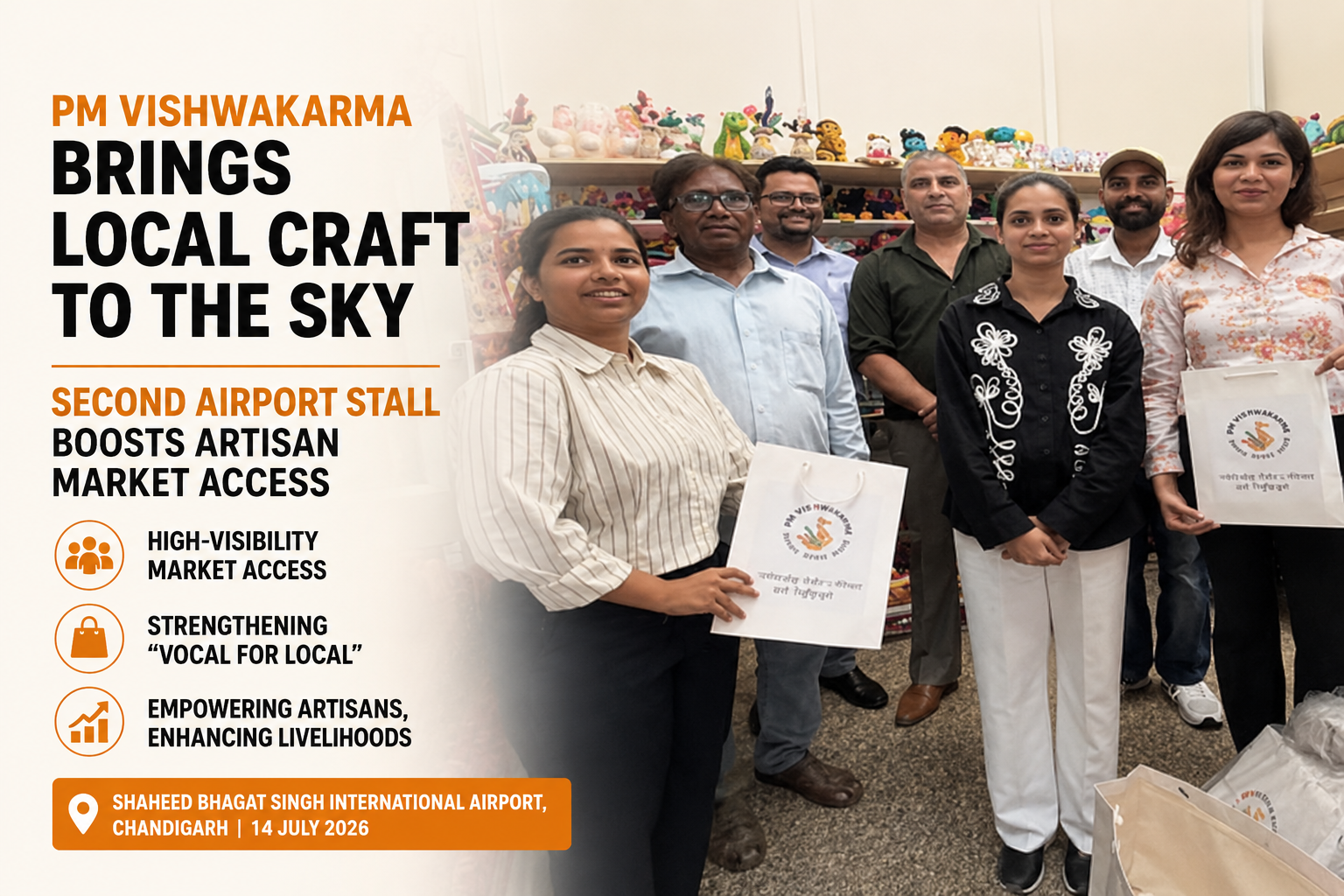
PM Vishwakarma’s second airport stall at Chandigarh’s Shaheed Bhagat Singh International Airport gave local artisans high-visibility market access, strengthening “Vocal for Local” and livelihoods.
The Ministry of Micro, Small & Medium Enterprises expanded a practical market bridge for traditional artisans when it inaugurated the second operational PM Vishwakarma (PMV) stall at Shaheed Bhagat Singh International Airport, Chandigarh, on 14 July 2026. Set up with support from NABARD and a local Self-Help Group, the stall offered three Chandigarh-based beneficiaries a strategic retail foothold in a high-footfall public space. The initiative, following the first operational PMV stall at Raja Bhoj Airport, Bhopal, illustrated how targeted market linkages can translate craftsmanship into sustainable income.
Airport launch and beneficiaries
The Chandigarh stall opened to travellers and visitors after a formal launch on 14 July. It is operated by three PMV beneficiaries: Shri Beju Tulsidas (basket maker), Kumari Shaista Rani (doll and toy maker), and Shri Rahul Kumar (potter). Each artisan brought unique, locally rooted forms of craftsmanship to the stall, turning the airport space into a micro-exhibition of Chandigarh’s traditional skills. By situating handmade goods where thousands pass daily, the stall converted transient footfall into concrete market opportunities.
High-visibility market access
Placing the stall inside an international airport amplified visibility for the artisans’ work. Domestic and foreign travellers now encounter authentic Indian handicrafts during transit, creating chances for impulse purchases, gifting, and cultural discovery. This visibility helps artisans test product designs and presentation directly with diverse customers, accelerating feedback loops that are crucial for product refinement and pricing strategies.
Supporting Vocals for Local and Atmanirbhar Bharat
The airport stall advances the government’s ‘Vocal for Local’ and ‘Atmanirbhar Bharat’ priorities by promoting indigenous production and local entrepreneurship in premium public venues. The move signals a practical commitment to creating demand-side linkages rather than merely offering supply-side assistance. When travellers buy locally made products at airports, they contribute to regional economies and help formalize artisan incomes.
Skill development to market linkage
The PM Vishwakarma Scheme supports artisans across 18 trades through recognition, skill training, modern toolkits, collateral-free credit, and digital incentives. This airport stall demonstrates the market linkage component in action: beneficiaries not only gain sales space but also learn retail skills—product display, packaging, customer interaction, and digital payment handling. These experiential learnings improve their readiness for larger commercial platforms and repeat orders.
Collaborative implementation
The Chandigarh stall was developed in collaboration with NABARD and a Self-Help Group, reflecting the multi-stakeholder approach needed for sustainable artisan market access. NABARD’s involvement helps ensure financial and institutional support, while SHG participation strengthens community-level organization and scalability. Such partnerships lower barriers for artisans to enter formal retail channels.
Economic and social impact
Operational stalls at airports can produce measurable benefits: increased monthly revenues, broader customer demographics, and visibility that attracts bulk buyers and boutique retailers. Beyond income, the stalls raise artisans’ social recognition-validating traditional crafts as valuable contributions to India’s cultural economy. For many PMV beneficiaries, the airport presence helps bridge the gap between rural or small-town production and urban market demand.
Lessons and future potential
This second airport rollout provides practical lessons for scaling. Key takeaways include the importance of curated product assortments that suit traveller buying behavior, attractive and durable packaging for transit sales, staff or training support to manage stalls during peak hours, and digital payment readiness. Replicating the model at other airports and transit hubs could create a network of premium retail platforms for artisans nationwide.
Conclusion
The PM Vishwakarma stall at Shaheed Bhagat Singh International Airport turned a busy transit space into a launching pad for artisanal growth. By combining government initiative, financial institution support, and local organization, the project connected skilled craftspeople with wider markets, strengthened livelihoods, and promoted India’s handmade heritage on an international stage. As the PMV scheme expands its market-linkage footprint, such airport stalls can become catalysts for sustained artisan empowerment and for making ‘Vocal for Local’ visible to millions.
#PMVishwakarma #VocalForLocal #AtmanirbharBharat #MSME #ArtisanEmpowerment #Handicrafts #AirportRetail #NABARD #ShaheedBhagatSinghAirport #MarketLinkages
Disclaimer
The information in this article is based on available public sources and official statements as of the time of publication. While we aim for accuracy, we do not guarantee completeness or correctness. We advise readers to verify key details from official sources before making any decisions. The website (fashionsamvaad.com) is not liable for any loss or damage arising from the use of this content. The authors are also not responsible for any such loss or damage.
Free preview of advan