









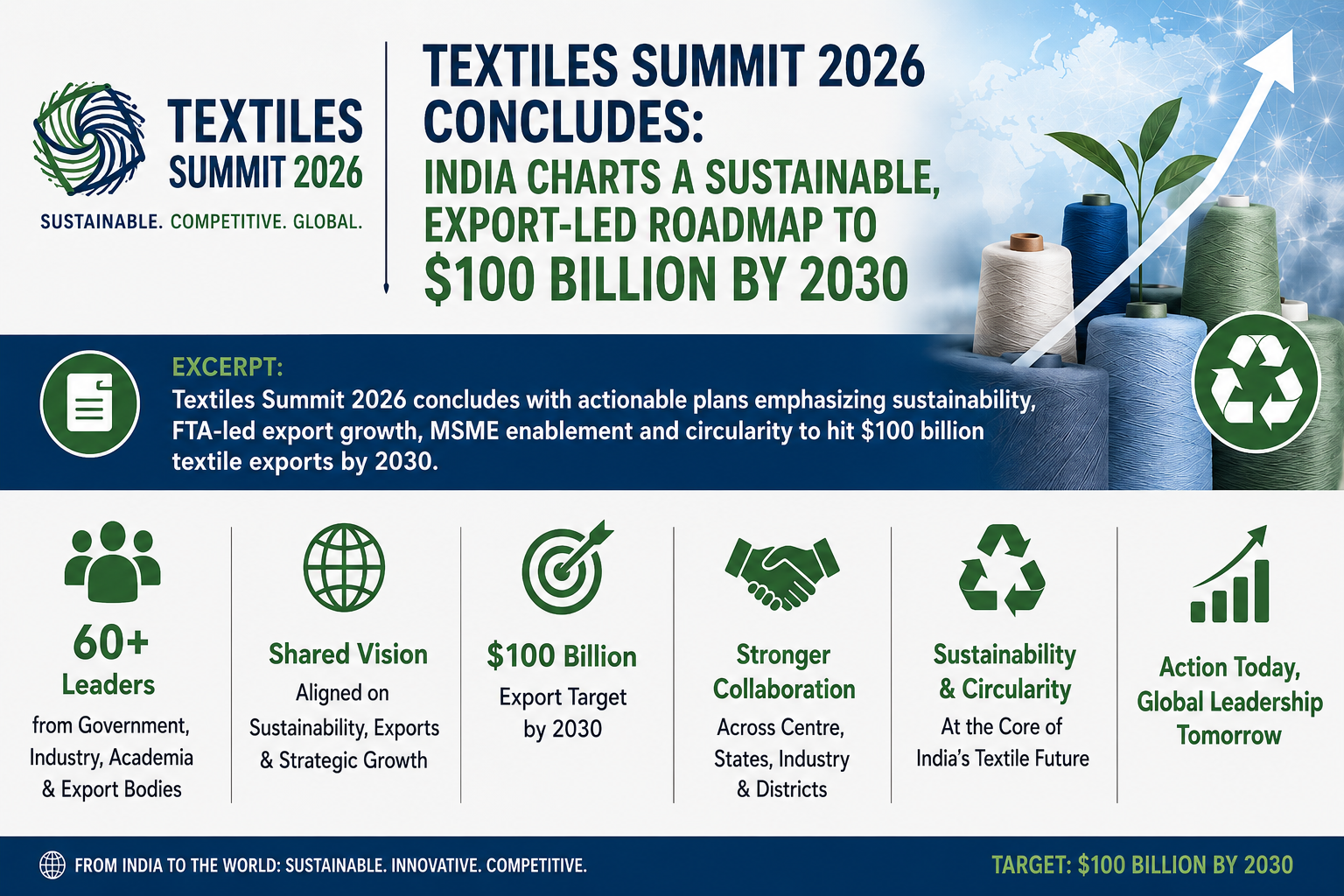
Textiles Summit 2026 concludes with actionable plans emphasizing sustainability, FTA-led export growth, MSME enablement and circularity to hit $100 billion textile exports by 2030.
Textiles Summit 2026, held on 23–24 June, concluded with clear calls to move from dialogue to decisive action across India’s textile ecosystem. The two-day event brought together Union and State officials, industry leaders, exporters, and academics to align on sustainability, export enablement and strategic market expansion. Leaders stressed practical steps-district-level execution, value addition, and institutional coordination-to transform India’s textile ambitions into measurable outcomes.
Shared Vision: From State Plans to District Execution
Union Minister of Textiles Shri Giriraj Singh urged stakeholders to convert state and district plans into concrete action with a proactive mindset. He emphasized tailoring product-market mixes, enhancing value addition, and ensuring compliance with environmental standards. The Minister called for exploiting niche product strengths and leveraging Free Trade Agreements (FTAs) to boost competitiveness in target markets.
From Recommendations to a National Export Roadmap
Secretary, Ministry of Textiles Smt. Neelam Shami Rao framed the summit’s outcome as a decisive shift toward implementation. She committed to translating recommendations from states, districts, industry and Export Promotion Councils into a comprehensive National Textile Export Roadmap. The roadmap will prioritize high-value segments, innovation, quality and sustainability, backed by stronger institutional frameworks to raise India’s share in global textile trade.
Leveraging FTAs and District Export Hubs
Commerce Secretary Shri Rajesh Agrawal focused on the immediate need for the industry to harness recently concluded FTAs. He highlighted the Department of Commerce’s outreach-500 workshops and praised the summit booklet “Leveraging recent FTAs – a Textiles perspective.” Agrawal also urged states and UTs to join the revived District as Export Hubs (DEH) initiative to address information asymmetry at the district level and help exporters exploit tariff advantages effectively.
Sustainability, Traceability and Circularity
One of the summit’s core sessions examined quality, sustainability certifications and sourcing decisions. Delegates outlined steps to translate global brand requirements into cluster-level strategies and promote digital product passports for improved traceability. Participants explored closed-loop recycling pathways, reinforced collaboration between municipal bodies and states for textile waste management, and recommended bridging academic R&D with commercially viable recycling systems. Simplifying compliance for MSMEs and harmonizing national policies with international regulatory trends also featured prominently.
Export Enablement and Market Diversification
The final session mapped out export enablement strategies focused on FTA utilization, market diversification and improving ease of doing business. Speakers advocated targeting tariff benefits while maintaining high sustainability and standards. The discussion stressed attracting anchor investors, promoting product diversification-especially in man-made fibres (MMF)—and building in-house design capabilities to respond rapidly to consumer trends. The summit highlighted measures to create globally competitive “Champion MSMEs,” strengthen export finance and risk mitigation, and launch strategic market access initiatives to promote Brand India.
State Presentations and Actionable Insights
On Day Two, states and UTs presented group summaries of breakout sessions, offering strategic recommendations and practical action points. These presentations underlined local strengths, cluster-level interventions, and export-oriented proposals aligned with the sector’s USD 100 billion export target by 2030. District-level strategies, skills development, and strengthened industry-academia linkages appeared repeatedly as immediate priorities.
Key Outcomes and Next Steps
The summit ended with consensus on turning deliberations into a time-bound action plan. Ministries committed to closer inter-agency coordination, wider dissemination of FTA benefits, and support mechanisms for MSMEs to meet compliance and sustainability standards. The government signaled follow-up measures including capacity-building workshops, pilot recycling projects, and incentives for high-value manufacturing clusters.
Main Highlights
- Strong push to operationalize district and state textile plans.
- Commitment to develop a National Textile Export Roadmap.
- Emphasis on using FTAs and reviving District as Export Hubs.
- Focus on digital product passports, closed-loop recycling, and waste management.
- Prioritization of MSME enablement, design capabilities, and MMF-led diversification.
- Over 500 Commerce Department workshops and distribution of practical FTA guides.
#TextilesSummit2026 #SustainableTextiles #TextileExports #FTA #DistrictExportHubs #CircularEconomy #MMF #ChampionMSMEs #DigitalProductPassport #BrandIndia