




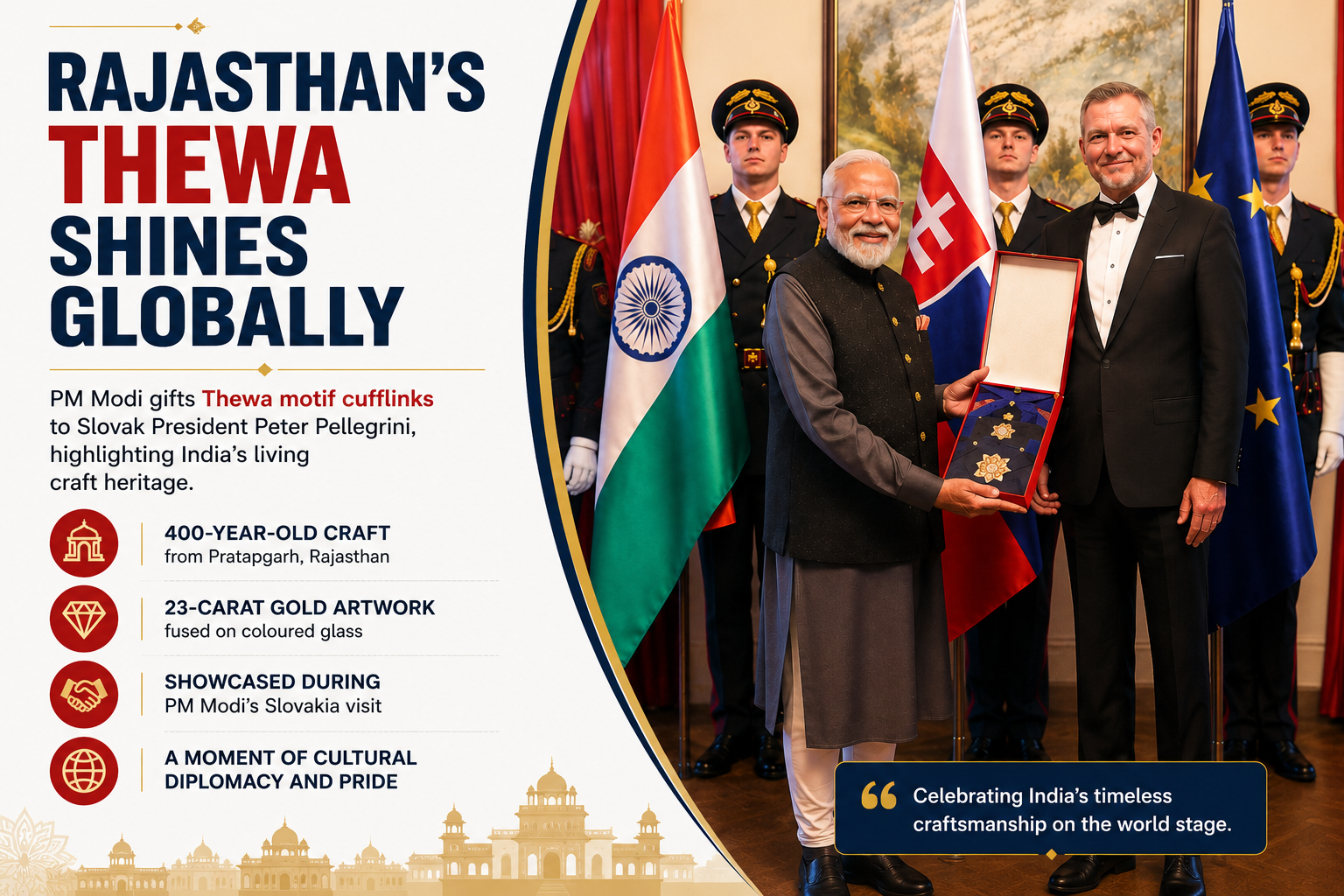
Prime Minister Narendra Modi showcased Rajasthan’s centuries-old Thewa art by gifting Thewa motif cufflinks to Slovakia’s president, spotlighting India’s living craft heritage.
During Prime Minister Narendra Modi’s recent visit to Slovakia, a small but powerful symbol of India’s artisanal heritage made an international impression. Modi presented Thewa motif cufflinks to Slovak President Peter Pellegrini, placing the centuries-old Pratapgarh art form briefly but memorably on the global stage. The gesture underscored how cultural diplomacy can elevate traditional crafts and create fresh opportunities for artisans.
What is Thewa?
Thewa is a specialized craft that fuses 23-carat gold impressions with vividly colored glass. Originating in Rajasthan’s Pratapgarh district around the Mughal era, Thewa involves engraving delicate patterns in gold and permanently fusing them onto multicolored glass bases. The result is a luminous ornament that carries intricate detail and enduring visual appeal. Artisans must combine steady hands, patient attention, and precise technique to produce each piece.
Local artisans gain recognition
Mandsaur-based artisan Rakesh Soni -who trained under his maternal uncle in Pratapgarh and has practiced Thewa for nearly 25 years – welcomed the diplomatic spotlight. He said Prime Minister Modi’s presentation helped raise wider recognition for Thewa and similar traditional arts. Soni has also crafted a special Thewa brooch for the Prime Minister and hopes to present it personally, reflecting how national-level visibility motivates artisans to innovate while preserving traditional methods.
Craftsmanship and process
Thewa work demands meticulous steps. Artisans first prepare multicolored glass discs, then trace or cut intricate designs from a thin sheet of 23-carat gold. They attach these gold filigrees onto the glass and apply heat and finishing to set the design permanently. According to Soni, a single set can take around three days to complete – a testament to the patience and precision the craft requires. This time-intensive process explains both the uniqueness and the economic value of authentic Thewa pieces.
Cultural significance and livelihoods
Beyond aesthetic value, Thewa sustains livelihoods across regions connected to its practice. Families in and around Pratapgarh have preserved techniques across generations, transmitting patterns, tooling knowledge, and finishing skills by apprenticeship. The diplomatic presentation in Slovakia emphasized that traditional handicrafts are not relics but living cultural assets that generate income and bolster community identity. For many artisans, such recognition translates to commissions, collaborations, and market access beyond local or national boundaries.
International visibility through diplomacy
Gifting a culturally resonant object during a state visit has long been a diplomatic practice; in this instance, the choice of Thewa cufflinks communicated India’s craftsmanship and cultural continuity. International exposure often leads to practical benefits – increased media coverage, invitations to craft fairs, and opportunities to work with designers or exporters. Soni and others expressed gratitude that Thewa reached new audiences through the Prime Minister’s gesture, helping secure demand and respect for handmade Indian arts.
Challenges and preservation
Despite its beauty and heritage, Thewa faces familiar challenges: competition from cheaper mass-produced substitutes, limited access to global markets for small artisans, and the need to train younger generations. Preserving Thewa requires coordinated support – recognition through awards and GI tags, training programs, better market linkages, and promotion in both traditional and contemporary design contexts. The diplomatic spotlight offers momentum that stakeholders can convert into sustainable support mechanisms.
Looking ahead
Artisans like Rakesh Soni view the Slovakia presentation as more than a single moment; they see it as a springboard. With growing interest from diplomats, collectors, and designers, Thewa artists can explore collaborations that respect traditional methods while expanding product lines – for example, brooches, cufflinks, pendants, and framed panels for interiors. Continued visibility, combined with institutional backing, can help ensure Thewa remains a vibrant craft for future generations.
Event highlights
- Prime Minister Narendra Modi gifted Thewa motif cufflinks to Slovak President Peter Pellegrini during a state visit.
- The gesture showcased Thewa art – 23-carat gold engravings fused on multicolored glass – from Pratapgarh, Rajasthan.
- Artisan Rakesh Soni of Mandsaur, a practitioner for nearly 25 years, welcomed the international recognition.
- Soni created a special Thewa brooch for the Prime Minister and aims to present it personally.
- Thewa work takes roughly three days per set and dates back nearly 400 years to the Mughal period.
- The diplomatic moment generated renewed discussion about craft preservation, livelihoods, and market access.
#Thewa #RajasthanCrafts #HandmadeIndia #CulturalDiplomacy #IndianArtisans #ModiInSlovakia #Pratapgarh #GoldOnGlass #ArtisanLivelihoods #TraditionalCrafts